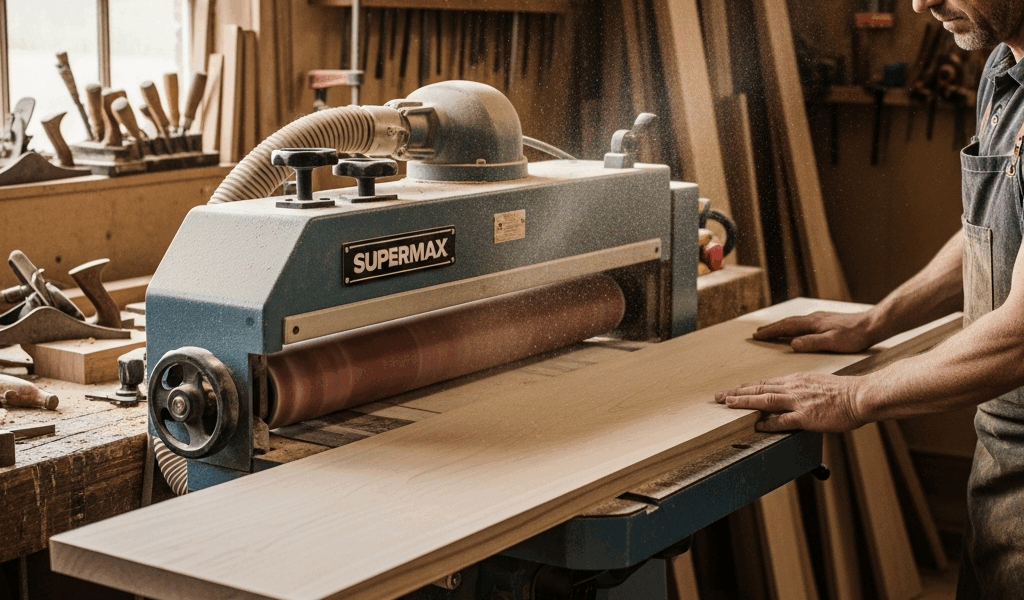
Supermax Drum Sander — Is It Worth the Money for Furniture Makers?
I’ve been running a Supermax drum sander through its paces for about three years now, and the question I get most from other one-person shop owners is always the same: is the Supermax drum sander review hype real, or is it another tool that looks better in YouTube videos than it does on actual job sites? I’ll give you the honest answer, built from finishing dining tables, credenzas, bed frames, and probably forty or fifty cabinet face frames over that span. No affiliate fluff. No manufacturer talking points. Just what I’ve learned by feeding real boards through a real machine.
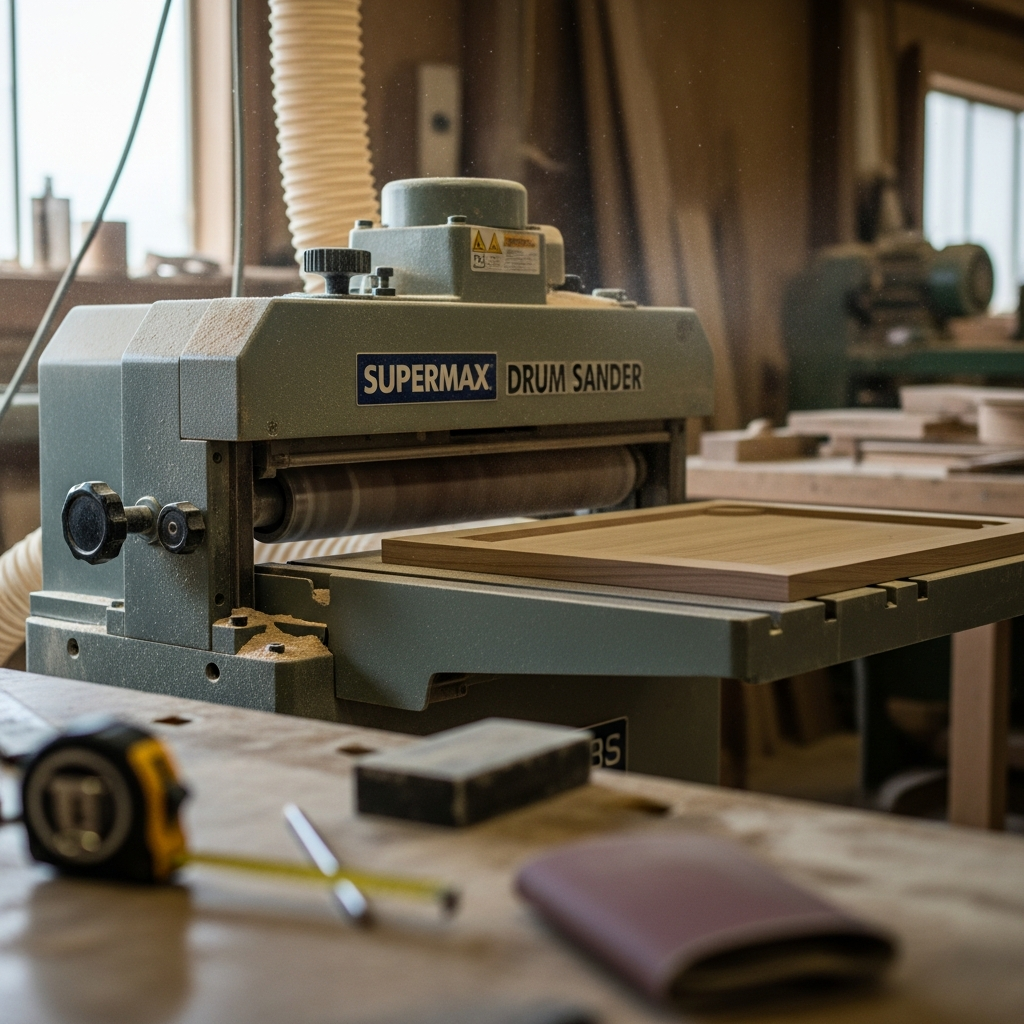
The short version is that the Supermax 19-38 changed how I price jobs. The longer version takes some explaining.
Before I bought the 19-38, I was hand-sanding every tabletop. Random orbital, a lot of 80-grit, aching forearms. I was spending two to three hours on a single dining table surface that the drum sander now handles in about fifteen minutes of actual machine time. That’s not a small thing when you’re billing hourly on custom work.
What the Supermax 19-38 Actually Does Well
Board Thickness Consistency
This is where the machine earns its price tag, full stop. I build furniture with solid hardwood — mostly white oak, walnut, and hard maple — and glued-up panels are a constant source of frustration when individual boards come off the planer at slightly different thicknesses. We’re talking 1/32-inch or even 1/64-inch variations that you absolutely feel when you run your hand across a glue joint.
The Supermax 19-38 flattens those joints out. Properly. I’ve run walnut panels through at 220 inches per minute on the lower feed rate setting and come out with surfaces that require nothing more than a final pass with 180-grit on a random orbital before finishing. That’s it. The drum does the leveling work that used to take me 45 minutes of hand-sanding after the planer.
The drum itself on the 19-38 is a conveyor-belt design with a rubber-covered steel drum, and it maintains contact across the full 19-inch width without the edge-lifting you sometimes get on cheaper machines. I’ve tested this by pencil-marking a panel edge-to-edge before a pass and checking which marks remained. On the Supermax, marks come off evenly. On a friend’s older Ryobi benchtop unit, the edges always stayed a few thousandths thicker. Not a knock on him — just a different class of machine.
Wide Capacity for Tabletops and Panels
The 19-inch capacity is the spec that matters most for furniture work. Most dining tables I build are between 36 and 42 inches wide at the finished top. That sounds like it blows past the 19-inch drum width, but the trick with any drum sander is the double-pass method — run the panel halfway through, flip it 180 degrees, feed the other half. Works perfectly on the Supermax as long as you’re consistent with your depth settings between passes.
I’ll be honest: I screwed this up twice early on. Set the drum depth slightly different on the second pass and left a faint ridge down the center of a maple tabletop. Took a full evening of hand work to fix it, and I had to refund the client part of the job cost. That was a $60 lesson in marking your depth wheel position before you flip a panel. Now I put a piece of tape on the wheel with a marker line. Problem solved.
The 38-inch capacity figure in the model name refers to the effective width you can sand using that double-pass technique. In practice, I’ve successfully surfaced panels up to 36 inches wide on a single setup. For the furniture scale most one-person shops work at, that covers almost everything.
Feed Rate Results
The variable speed conveyor on the 19-38 runs from roughly 0 to 10 feet per minute. I run most hardwoods at around 3 to 4 feet per minute with 80-grit for initial flattening, then bump it to 6 or 7 feet per minute for finish passes with 120 or 150-grit. Softer woods like poplar or alder can move faster even at coarser grits without burning.
Snipe — that dip at the leading and trailing edge of a board — is minimal on this machine. Noticeably better than the Performax 16-32 I demoed at a friend’s shop. Not zero, but we’re talking maybe 3/16 of an inch at each end that I leave as waste on longer stock anyway.
The Drawbacks Nobody Mentions
Dust Collection Requirements
Quick note before the rest of this. The Supermax 19-38 produces a truly impressive volume of fine sanding dust, and the machine itself does almost nothing to contain it without a dedicated dust collector. The dust port is 4-inch. That seems fine until you realize that at aggressive depth settings with 80-grit, you’ll overwhelm a standard shop vac in about ten minutes of continuous use.
You need a real dust collector. I’m running a Jet DC-1100VX with a 1-micron bag, and it keeps up, but just barely during heavy sessions. Several woodworking forums mention pairing the Supermax with at least a 1.5 HP collector. I’d say 1.5 HP is the floor, not the recommendation. Fine dust from drum sanding is not the stuff you want floating around a shop all day.
Budget for the dust collection infrastructure when you’re pricing out this machine. Add $300 to $500 to the real cost of ownership if you don’t already have a proper collector. The Supermax 19-38 retails around $1,299 to $1,499 depending on where you buy it and current promotions. Woodcraft and Rockler both carry it. That dust collector cost matters in the total math.
The Learning Curve on Feed Speed
The variable feed conveyor has no numerical readout. You’re adjusting a knob and learning by feel and result. For the first month or so, I was either burning wood (too slow) or leaving chatter marks from too-aggressive depth combined with too-fast feed. Burning shows up as brown streaks across the surface and ruins the grain appearance on open-pored woods like oak. Chatter looks like shallow scallops and shows up badly under a raking finish coat.
The fix is simple but takes time to internalize: never take more than 1/32 inch per pass on hardwood. Some people push 1/16 inch. I’ve done it. The results aren’t worth it. Slower, shallower passes produce better surfaces and put less strain on the motor. The 1.75 HP motor on the 19-38 handles typical furniture stock without complaint, but you’ll hear it labor when you push too deep on a wide, dense panel.
Sandpaper Costs Over Time
This one adds up in ways you won’t predict until you’re six months in. The 19-38 uses hook-and-loop drum sleeves, and they’re not cheap. A box of five 80-grit sleeves from Supermax runs about $28 to $32 depending on where you buy. I go through roughly two 80-grit sleeves per medium-scale project (a table plus four chairs, say). That’s $12 to $15 in sandpaper per project before you add the 120 and 150-grit finish passes.
Frustrated by burning through sleeves faster than expected, I started tracking consumption per project in a simple spreadsheet. Over 12 months, I spent $340 on drum sleeves alone. Not ruinous, but it’s a real operating cost that the machine’s purchase price doesn’t capture. Build it into your shop rate. I now add $8 per project as a “consumables” line item, which covers sandpaper across all my machines for that job.
Third-party sleeves exist and some are decent. I’ve had good results with a brand called SuperGrit. Mixed results with the really cheap imported ones — they shed grit early and the hook-and-loop backing delaminates after one or two uses.
Supermax vs Performax vs Jet — Quick Comparison
These three brands occupy essentially the same price band for 16-to-19-inch drum sanders aimed at serious hobbyists and small professional shops. Having used all three in working shop environments, here’s where they actually differ:
Supermax 19-38
- Street price — $1,299 to $1,499
- 19-inch drum width, 1.75 HP motor
- Strongest conveyor belt tracking in this class — rarely wanders off center
- Best depth adjustment precision of the three (locking knob with indicator)
- Dust collection could be more robust at this price
- US-based customer support that actually answers the phone — I’ve called twice
Performax 16-32 Plus
- Street price — $699 to $799 (sold through Woodcraft)
- 16-inch drum, 1.75 HP motor
- Lower entry cost but the 3-inch narrower drum is a real limitation on wider panels
- Adequate for smaller work — jewelry boxes, small shelves, cutting board flattening
- Noticeable edge-thickness inconsistency on panels wider than 14 inches
- Feed belt tracks less reliably — requires periodic manual adjustment
Jet 10-20 Plus
- Street price — $1,099 to $1,199
- 10-inch drum (expandable to 20-inch with open-ended design)
- Very solid build quality, particularly the cast iron table
- The open-end design allows oversized panels to pass through — theoretical advantage
- In practice, wide unsupported panels flex and cause inconsistent cuts
- Motor runs noticeably hotter during extended sessions than the Supermax
The honest summary: if your budget is under $800, the Performax handles lighter furniture work. If you’re building dining tables, bed frames, and wide cabinet panels regularly, the Supermax is the right machine. The Jet sits in an awkward middle — competitive on paper, slightly frustrating in daily use.
One thing worth noting: Supermax is a Minnesota-based company. Parts and sleeves are genuinely available domestically without long shipping delays. That matters when a drum sleeve wears out mid-project and you need a replacement in two days.
Is It Worth It for a One-Person Shop?
The Dollar-Per-Use Calculation
Let’s do real math here. I paid $1,349 for my 19-38 in early 2022. Add $420 in dust collection upgrades (new filter bag and a longer flex hose to reach the machine from my existing collector) and the real out-of-pocket was $1,769. Over three years, I’ve run probably 140 significant projects through it — tables, panels, face frames, slabs. That’s $12.64 per project in machine cost, before consumables.
Before the drum sander, I was spending an average of 2.5 hours hand-sanding panel surfaces on furniture projects. Now that’s 20 to 30 minutes including setup. At my shop rate of $75 per hour, that’s $150 to $165 in recovered time per project. Even counting the $8 in consumables, I’m netting over $140 in recaptured labor per project. The machine paid for itself in fewer than 13 projects.
That’s not a theoretical number. That’s what actually happened.
When to Buy
Buy the Supermax 19-38 if you’re building furniture at a pace of at least one medium project per month. Buy it if you work with glued-up panels regularly. Buy it if you’re currently losing hours to hand-sanding flat surfaces that a machine could handle in a fraction of the time. Buy it if you’ve already priced drum sander rentals and found yourself going back to the rental shop three times in a quarter.
When a Hand Sander Is Actually the Right Call
Don’t buy the drum sander if your work is primarily small boxes, turnings, or carved pieces where surface geometry is irregular. The drum sander handles flat surfaces. That’s its entire job. Curved aprons, shaped seat blanks, sculptural legs — none of that goes through a drum sander. Hand tools and random orbitals still own that territory completely.
Don’t buy it if your shop has no dedicated dust collection and you have no plans to add it. You’ll create a dust situation that’s genuinely unpleasant and potentially hazardous to work in. The machine deserves proper infrastructure.
Don’t buy it if you’re building two or three projects a year as a hobby. At that volume, renting from a local woodworking club or shared shop makes more financial sense. Memberships at most shared shops run $80 to $150 per month and include access to machines like this.
The Verdict
Pushed into a buying decision after spending an entire Saturday hand-sanding a white oak dining table that should have taken ninety minutes, I ordered the Supermax 19-38 the following Monday. Best tool purchase I’ve made in a decade of running this shop. Not the most exciting machine in the shop — the bandsaw gets more compliments from visitors — but it’s the one that directly affects how much I earn per hour worked.
For furniture makers doing production work at the one-person-shop scale, this machine is not a luxury. It’s infrastructure. The $1,349 price point is real money, and I’m not dismissing that. But if you’re building and selling furniture, the time math is unambiguous. You will recover that cost. You will wonder what took you so long.
Three years in, the drum still runs true. The conveyor belt has never slipped. I’ve replaced it once — about $45 through Supermax’s parts line, and installation took 25 minutes. That’s the total unplanned maintenance cost so far. For a machine that runs multiple times per week in a working shop, that’s a track record worth something.



Stay in the loop
Get the latest artisan furniture makers updates delivered to your inbox.