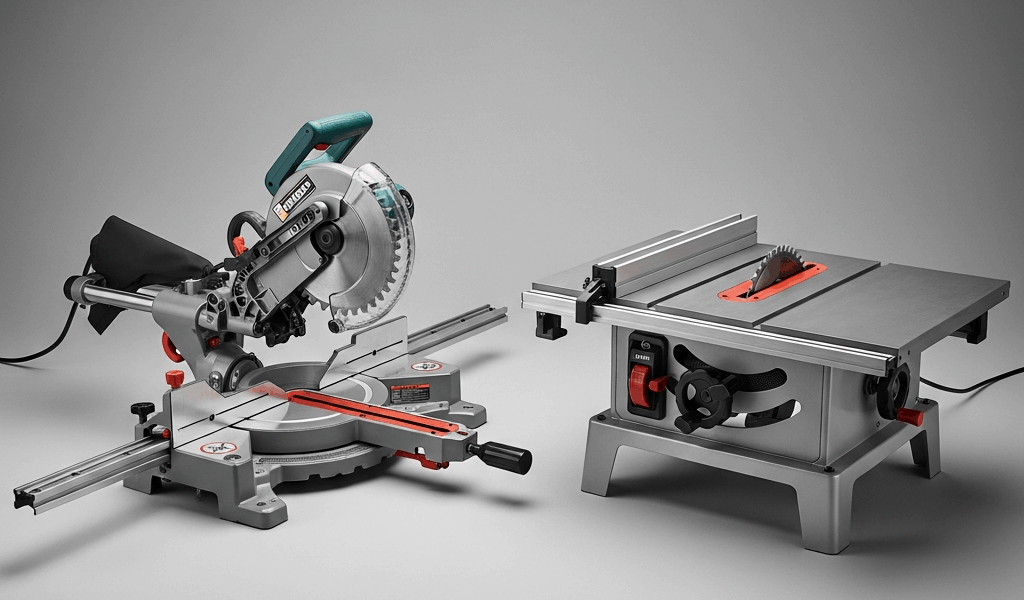
Sliding Compound Miter Saw vs Table Saw — Which Do You Need First?
The sliding compound miter saw vs table saw debate comes up in almost every beginner woodworking forum, every YouTube comment section, and every conversation I’ve had with someone standing in front of a half-finished workbench asking why nothing fits. I’ve been building furniture for going on eighteen years now, and I made this exact decision wrong the first time around. Bought a Bosch GCM12SD sliding compound miter saw for around $600 before I owned a table saw. Spent the next eight months wondering why my furniture projects kept stalling out at the same frustrating point. The answer, once I finally understood it, was obvious. But nobody had explained it to me clearly, so I’m going to do that here.
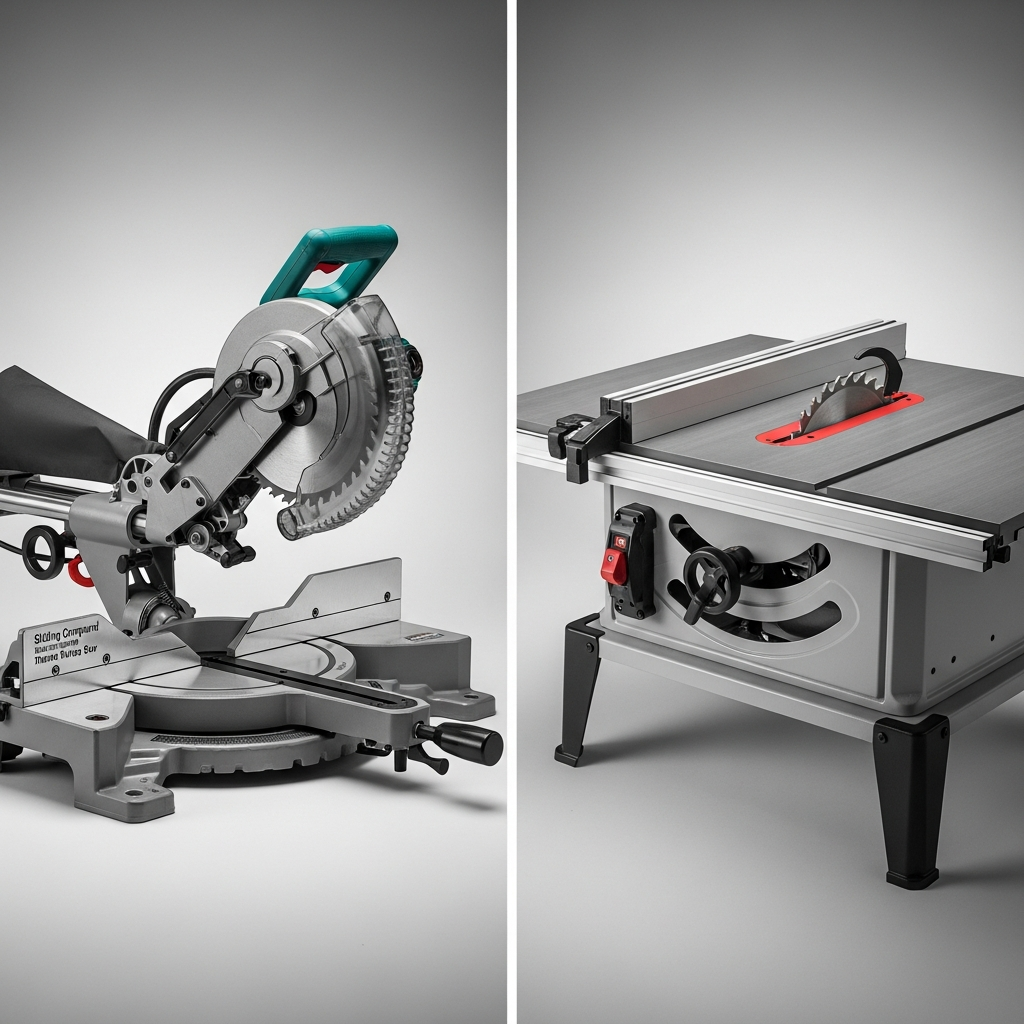
This isn’t a breakdown of specs and features. You can find that anywhere. This is the answer to the actual question furniture makers ask — if you can only buy one first, which one do you buy?
The Short Answer for Furniture Makers
Buy the table saw first. Full stop.
Here’s why that answer is so definitive: ripping is the bottleneck. When you’re building furniture — real furniture, not assembling flat-pack boxes — you constantly need to take a board that’s 6 inches wide and make it 3.5 inches wide. Or take a rough-cut piece of 8/4 walnut and dimension it down to something usable. That operation is called ripping, and a miter saw physically cannot do it. The blade runs perpendicular to the fence. You cannot feed a 6-foot board lengthwise through a miter saw. It’s not a limitation you can work around with technique or accessories. It’s geometry.
A circular saw can make rough crosscuts. A jigsaw can cut curves. A hand saw can get you through a board in a pinch. But nothing replaces the table saw for ripping lumber to width, and ripping is something furniture makers do on nearly every single project.
I learned this the hard way. Frustrated by a dining table build that required eight identical legs, I spent three hours trying to true up rough-sawn maple using a hand plane and a circular saw with a fence jig. It worked, sort of. The legs were close. But close isn’t furniture — close is firewood. When I finally bought a used Powermatic 66 for $800 off Craigslist and made those same cuts in twenty minutes, I genuinely sat down and looked at the ceiling for a while.
The Ripping Problem Nobody Talks About
Lumber yards sell boards in standard widths that almost never match what your project calls for. A design might call for a 4.25-inch wide rail. The board you have is 6 inches. Without a table saw, you’re stuck. You either redesign around the lumber you have — which is a real creative constraint that gets old fast — or you wrestle with a circular saw and a clamped straightedge, which produces results that are fine for rough construction and genuinely frustrating for furniture joinery.
Sheet goods make this even more stark. Plywood comes in 4×8 sheets. Breaking those down with a circular saw is acceptable for initial rough cuts. But getting a perfectly straight, square edge on plywood for cabinet carcasses, drawer bottoms, or tabletops? You need a table saw with a reliable fence. The Biesemeyer-style fence on most contractor and cabinet saws is what makes that possible. A circular saw with a guide rail gets close. Close enough for some applications. Not close enough for furniture drawers that need to slide smoothly.
Dado Joints Change Everything
Furniture makers also rely heavily on dado joints — flat-bottomed grooves cut across or along a board to receive a shelf, a drawer bottom, or a panel. A table saw with a dado stack (a set of stacked blades like the Freud SD508 8-inch set, which runs about $120) cuts these in a single pass. Clean, consistent, repeatable. A miter saw cannot cut dados. Not even close. A router can, with a jig, but the table saw is faster and more precise for the repetitive work that furniture making demands.
What the Miter Saw Does Better
The piece that matters most here — because the miter saw is genuinely excellent at what it does. The problem is that what it does isn’t the bottleneck for furniture makers.
A sliding compound miter saw like the Dewalt DWS780 (street price around $599) or the Festool Kapex KS 120 (a jaw-dropping $1,400, but extraordinary) makes crosscuts and angled cuts with a speed and accuracy that a table saw simply cannot match. Crosscutting means cutting across the grain — taking an 8-foot board and cutting it to 36 inches, for example. The miter saw does this in about three seconds. Perfectly square, or at whatever angle you’ve dialed in.
When Miters Actually Matter
Picture frames. Cabinet face frames. Window and door casing. Crown molding. These are the applications where a miter saw earns its place. Crown molding in particular is genuinely difficult to cut accurately on a table saw — the compound angles involved (spring angle plus miter angle) require either careful math and custom setups on a table saw, or a quick dial adjustment on a sliding compound miter saw. The miter saw wins that fight every time.
For furniture specifically, the miter saw shines when you’re building pieces with mitered corners — some table aprons, certain frame-and-panel doors, decorative molding applied to case pieces. The sliding feature on a sliding compound miter saw lets you crosscut boards up to 12 or 16 inches wide, which matters for wider stock.
Job Site and Space Considerations
A miter saw also wins on portability and footprint. It sits on a stand or a workbench, doesn’t require dust collection infrastructure to operate safely, and can be moved to a job site or a different part of the shop without significant effort. A cabinet saw weighs 400 pounds and stays where you put it. A contractor table saw like the Dewalt DWE7491RS (about $600) is more portable but still requires real floor space and a 20-amp circuit.
If your shop is a one-car garage, this matters. The table saw will take a permanent position in the center of that space. The miter saw lives against the wall until you need it.
What the Table Saw Does Better
The list here is longer. That’s the honest truth.
Ripping lumber to width. Resawing thicker stock (in combination with a band saw). Cutting sheet goods down to size. Cutting dados and rabbets. Cutting tenons for mortise-and-tenon joinery. Cutting tapers for table legs using a simple sled. Crosscutting with a miter gauge or sled — a table saw with a well-built crosscut sled is actually a very capable crosscutting machine, even if it can’t match a miter saw for speed and convenience.
Furniture Joinery Lives Here
Traditional furniture joinery — mortise and tenon, box joints, half-lap joints, rabbet joints — is primarily table saw work. You can cut a tenon cheek with a good tenoning jig. You can cut box joints with a simple shop-made jig. A router table handles some of this too, but the table saw is the foundational machine around which furniture joinery is organized. Built around a solid table saw, a shop can produce tight, accurate joinery. Without one, you’re constantly improvising.
Tapered legs are another table saw job. A simple shopmade tapering jig, a piece of maple with a notch cut out of it and a toggle clamp, turns a square blank into an elegant tapered leg in two passes. No other tool handles this as cleanly for production runs of four or eight legs at a time.
The Fence Is the Tool
People underestimate how much of a table saw’s value lives in the fence. A quality fence — the Vega Pro 40 aftermarket fence runs about $350 and is worth every cent — turns the table saw into a precision instrument. Set it to 2.75 inches and rip twenty boards. They will all be 2.75 inches. That repeatability is what furniture making runs on. No measuring, no marking, no individual fitting. Set the fence, run the boards.
The Two-Tool Setup Most Shops End Up With
Every serious woodworking shop I’ve ever visited has both tools. The debate over which to buy first only exists at the beginning, in the tight-budget phase that almost every woodworker starts in.
The typical progression looks like this: buy the table saw first and spend real money on it. A used cabinet saw in good condition — a Powermatic, a Delta Unisaw, an older SawStop — is a better investment than a new contractor saw at the same price point. A SawStop Contractor Saw runs about $1,700 new and is an excellent first serious table saw. Some woodworkers start with the Dewalt DWE7491RS at $600 to learn on, then upgrade later. Both paths work.
Limping along without a miter saw during that initial period is genuinely manageable. Use the table saw with a crosscut sled for rough crosscutting. It’s slower. It works. Budget $400–$700 for a quality sliding compound miter saw as the second purchase, usually 12 to 18 months after the first, once the table saw has paid for itself in project quality and time saved.
Budget Guidance for the First Purchase
Spend at least $500 on a new table saw, or $600–$900 on a used cabinet saw. Below that price point, the fences become unreliable, the tables aren’t flat, and the arbors wobble. A $299 contractor saw from a big box store will teach you frustration before it teaches you woodworking. The machine needs to be accurate before you can learn to work accurately on it.
For the miter saw, the Dewalt DWS779 (non-sliding, about $379) handles 90% of furniture shop crosscutting and saves $150–$200 over the sliding model. The sliding version matters most when you’re regularly crosscutting boards wider than 8 inches. Know your typical project before spending the extra money.
The One Situation Where the Order Flips
If your work is primarily trim carpentry, finish carpentry, or installing cabinetry rather than building it, buy the miter saw first. Trim work lives and dies on accurate miter cuts. A table saw doesn’t help you cope crown molding at an outside corner. For that specific application, the miter saw is the primary tool and the table saw is the secondary one.
But furniture making? Cabinets built from scratch? Chairs, tables, beds, shelving with joinery? Table saw first. Every time. The shop that has only a table saw can build furniture. The shop that has only a miter saw is limited to projects where nothing needs to be ripped to width — and those projects are rare in furniture making.
Buy the table saw. Set it up properly, flatten the top if it needs it, tune the fence until it’s parallel to the blade, and spend a few weeks learning to use it safely. You’ll know when you need the miter saw. It’ll be the moment you’re cutting your fifth miter joint of the day with a crosscut sled and wishing the whole process took three seconds instead of three minutes. That’s the right time to buy it.



Stay in the loop
Get the latest artisan furniture makers updates delivered to your inbox.