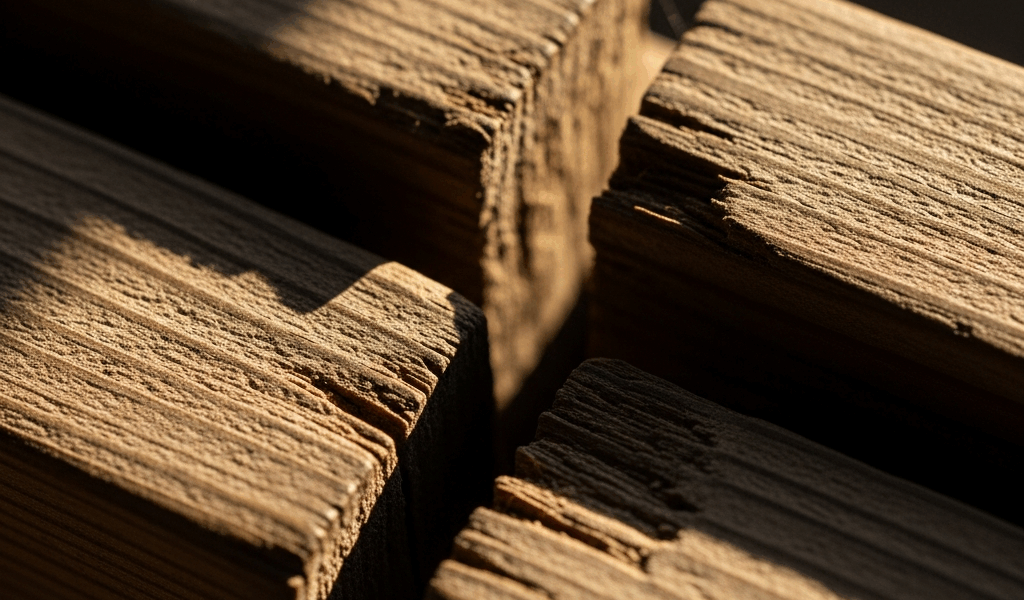
Why Joints That Looked Perfect Are Now Splitting
Wood movement has shifted noticeably with all the misinformation flying around about glue quality and joinery technique. As someone who ruined a walnut credenza back in 2015, I put in the hours studying why perfectly built joints eventually betray you. Today, I will share it all with you.
That credenza looked immaculate when I finished gluing the breadboard ends — clean lines, zero gaps, exactly what I’d planned. By January, one side had opened up a full half inch. The glue hadn’t failed. The joinery wasn’t sloppy. The wood had simply moved, and nothing I’d done accounted for that.
But what is wood movement, exactly? In essence, it’s the expansion and contraction of wood fibers as ambient humidity rises and falls. But it’s much more than that. A 14-inch tabletop can shift 3/8 inch seasonally in an average climate — and it will do this every single year, forever, whether your joint is ready or not.
Two failure patterns show up repeatedly. Seasonal gaps that open in dry winter air and close again by April. Then permanent cracks — grain-parallel splits that never fully heal and quietly destroy joints over years. Which one you’re dealing with changes everything about how you fix it.
Which Joints Are Most Vulnerable and Why
Not every joint fails equally. Three scenarios account for most of what I see in repair work, and they’re worth understanding individually.
Breadboard Ends Glued Full-Length
A breadboard end is the cross-grain piece attached perpendicular to a tabletop or panel. The geometry looks sensible right up until humidity drops and the main panel tries to shrink. Glued along its entire length, that breadboard becomes an immovable wall. The panel underneath pulls against it. Something cracks — usually the panel, sometimes the joint, often both.
The wood in the main panel moves linearly across the grain. The breadboard moves too, but only where the glue lets it. In the middle, it’s essentially anchored. The stress concentrates right there, at exactly the worst possible location. That’s what makes breadboard construction so unforgiving to woodworkers who skip this detail.
Wide Panel Frames with Cross-Grain Glue-ups
Cabinet sides and frame-and-panel doors carry the same risk. Glue a wide panel directly into a rigid frame and you’ve created a conflict — the panel wants to move across its width, the frame doesn’t move much at all, and the glue refuses to mediate. Stress accumulates at the corners, where the geometry is least forgiving. The panel cracks there first. Almost always.
Drawers and Cabinet Backs Pinned Rigid
I once built a four-drawer cherry chest — probably around 2009, using 1/2-inch Baltic birch for the drawer backs — and pinned every single back directly into the sides without slotted holes. Within two seasons, the backs had split their full length. The pins held perfectly. The wood simply had nowhere to go except through itself. Spare yourself the wrong turn I took. A glue failure at least gives you something to work with. A split panel is just a split panel.
How to Tell If Movement Is Actually the Cause
Important part first. Too many woodworkers replace glue, re-clamp joints, and refinish surfaces when the actual problem is atmospheric physics.
Use this diagnostic checklist:
- Do gaps open seasonally and close again? That’s wood movement. The joint isn’t failing — it’s moving with the wood, which is actually what you want. Seasonal gaps prove the glue held.
- Does the crack run parallel to the grain? Wood splits along the grain first. If the crack follows the grain direction, movement stress is pulling the fibers apart.
- Does the crack run perpendicular to the grain or diagonally? That usually points to joint fracture — the joinery itself gave way, not the wood fibers.
- Look at the finish near the joint. Cracking or peeling finish film right at the joint line means wood movement is flexing that zone while the finish stays rigid. Most people miss this early warning entirely — until it’s too late and they’re looking at a full refinish job.
- Which season did you first notice it? Appearing in January or August — not March or October — puts humidity cycling at the top of the suspect list.
One more test worth doing: press your fingers into any gap that opened seasonally. It should feel solid — no flex, no play in the joint structure itself. That confirms wood movement over joinery failure, and it changes your entire repair approach.
How to Fix It Without Rebuilding the Piece
Not every movement failure means starting from scratch. The repair depends on joint type and how far things have deteriorated.
Breadboard Ends
If the breadboard is structurally sound and you’re only dealing with seasonal gapping, remove the glue beyond the first inch of the joint. A router and a sharp 1/2-inch chisel will get you there — carefully. Then install slotted screw pockets in the breadboard at 4-inch intervals, slots running perpendicular to the main panel grain. #10 wood screws work better here than bolts — easier to back out and adjust later. The panel moves. The breadboard stays aligned. Nobody fights anybody.
Panel Frames
This repair is harder, honestly. For panels that are gapping at the frame edges but not yet cracking, try releasing the glue on one edge — usually the bottom or a back edge — using a thin-kerf saw blade and slow oscillating passes. Leave the top and sides intact. One free edge lets the panel breathe in one direction, keeps it centered enough to function, and buys another decade before a real rebuild becomes necessary. Not elegant, but effective.
Pinned Backs and Rigid Assemblies
Once the wood has split, cosmetic repair is your only real option short of rebuilding. For preventing future splits, pull every other pin and replace those locations with slotted holes — 1/4-inch slot, centered on the original hole position. The back will rack slightly. Accept that. The alternative is watching it split again in 18 months.
How to Build It Right the Next Time
Prevention beats repair by a wide margin — probably 10-to-1 in time saved, based on what I’ve tracked across my own projects.
On breadboard ends, glue only the center 3 to 4 inches. The outer portions stay either unglued or attached with hide glue, which is reversible if things go sideways later. Wooden buttons or slotted metal clips — I’ve used both Rockler’s #10 slotted plates and shop-cut oak buttons — hold the breadboard loosely enough for movement. That’s what makes breadboard construction endearing to us woodworkers who’ve actually watched a panel split: you’re designing for physics instead of fighting it.
For wide panels in frames, floating panels aren’t optional. Leave them 1/8 inch proud in the groove, never glue all four edges, and consider quartersawn lumber where the budget allows — it moves roughly half as much across the grain as flatsawn. A 14-inch quartersawn top might shift only 1/4 inch instead of 3/8 inch seasonally. That extra 1/8 inch of margin matters more than it sounds.
Acclimate your lumber before milling. I’m apparently more disciplined about this than most people I know, and stacking boards in the shop for two to three weeks before touching them at the jointer works for me while skipping acclimation never does. It can reduce maximum future movement by up to 40 percent. There’s no real excuse to skip it — it costs nothing except patience.
So, without further ado, let’s nail the last principle: use mechanical fasteners across the grain wherever glue would create a conflict. Mortise-and-tenon, dowels, wooden buttons — all fine. Glue running perpendicular to grain direction is the enemy. Learn which direction your wood moves and design around it from the start.
Your next piece won’t split like that credenza did.



Stay in the loop
Get the latest artisan furniture makers updates delivered to your inbox.