
Why Most Floating Shelves Fail
Floating shelves have become harder to navigate with all the hardware store gimmicks and “easy install” kits flying around. As someone who’s built and hung more shelves than I can count — for my own shop, for clients, and for friends who got burned by the cheap stuff — I got hands-on with making shelves that actually stay on the wall. Today, I will share it all with you.
This article includes affiliate links. We may earn a commission at no extra cost to you.
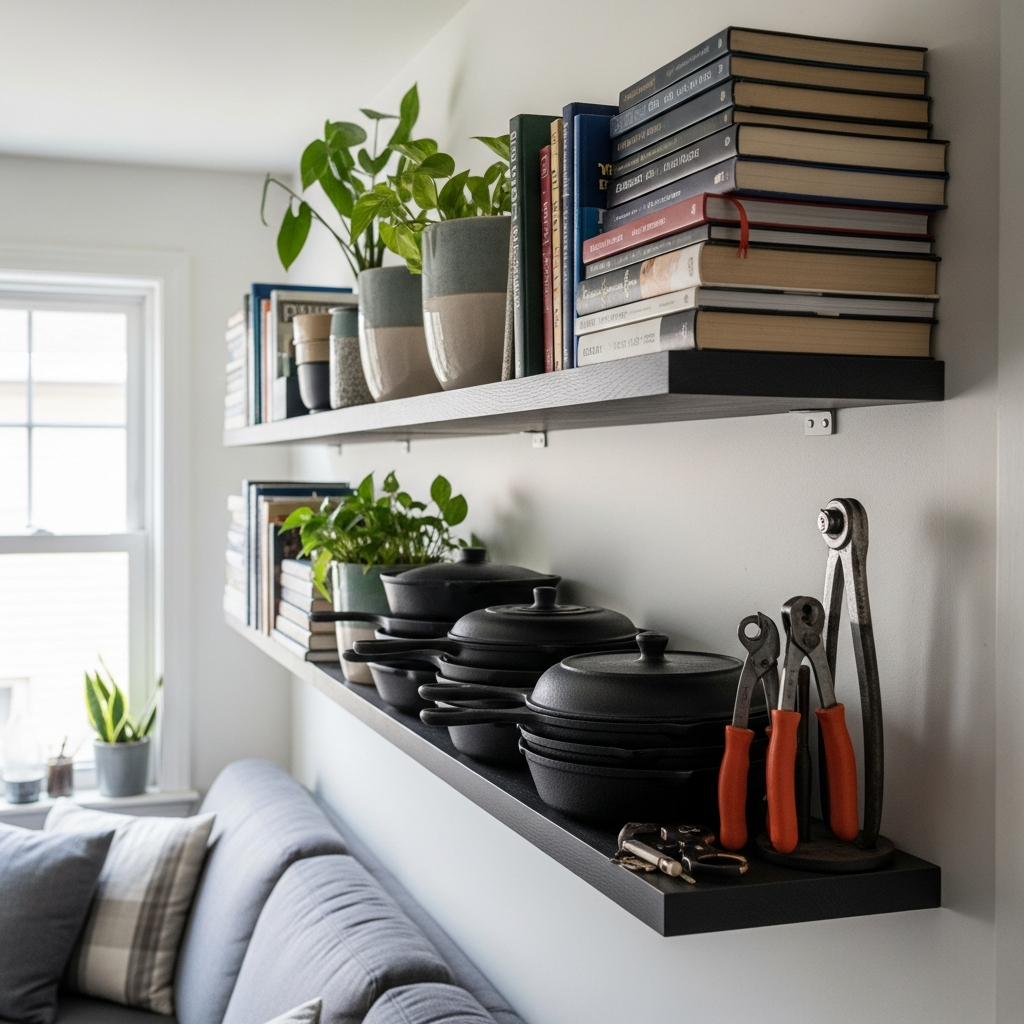
Walk into any big box store and you’ll find floating shelves rated for 15 or 20 pounds. Sounds decent, right? Hang them on the wall, load them with books, and within months they’re sagging, pulling away from the wall, or crashing to the floor entirely. I’ve been called to fix so many of these failed installations that I could probably wallpaper my shop with the broken mounting brackets. The problem isn’t the shelf itself — it’s the mounting system. A proper hidden cleat method creates floating shelves that hold 50, 75, even 100 pounds without any visible support.
This project teaches the French cleat variation specifically designed for floating shelves, combined with a hollow-core construction that minimizes weight while maximizing strength. The result is furniture-grade shelving that actually performs as advertised.
Understanding the Forces
Probably should have led in this section, frankly. A loaded shelf applies two forces to its mounting: downward load from the weight, and rotational torque as that weight tries to tip the shelf away from the wall. Cheap mounting systems handle the first force adequately but completely ignore the second. That’s why they fail — it’s not the weight pulling them down, it’s the leverage prying them off.
The hidden cleat method addresses both forces through interlocking geometry that resists rotation. The system uses two mating pieces: a wall-mounted cleat that angles down toward the wall, and a shelf cleat that angles up. When engaged, these angled surfaces lock together, and the shelf physically cannot tip outward without first lifting straight up. With the shelf loaded, lifting is impossible — the system becomes self-locking under load. It’s genuinely elegant engineering, and it’s been around for centuries.
Wall Cleat Construction and Mounting
That’s what makes French cleats endearing to us woodworkers — such a simple concept that does so much heavy lifting, literally. Cut the wall cleat from 3/4-inch hardwood, 3 inches wide and the full length of your planned shelf minus 1/4 inch. Rip one edge at 45 degrees, creating a beveled face that angles toward the wall at the bottom. This beveled edge faces outward when mounted.
Locate wall studs across your intended shelf location. The cleat must hit at least two studs for adequate support — for shelves over 36 inches, aim for three. Mount the cleat using 3-inch construction screws driven through the thick portion of the cleat into studs, spacing screws every 16 inches. I pre-drill everything here because hardwood splits are not something you want to deal with once the cleat is up on the wall.
Check level obsessively. I’m talking about checking it after every single screw. A level cleat produces a level shelf; an out-of-level cleat guarantees a tilted shelf that no amount of shimming can correct after the fact. I learned this lesson once and never had to learn it again.
Building the Hollow-Core Shelf
Solid wood shelves of any significant size become prohibitively heavy, and that weight works against your mounting system from day one. A torsion-box design provides equivalent stiffness at a fraction of the weight. Start with two pieces of 1/4-inch plywood cut to your shelf dimensions. These become the top and bottom faces.
Create an internal grid from 1-inch wide strips of 3/4-inch plywood, arranged in a rectangular pattern with cells approximately 4 inches square. Glue this grid to the bottom face panel, then glue the top panel over the grid, clamping or weighting until the glue cures. I use whatever heavy stuff is handy — paint cans, cast iron, bags of sand. You don’t need fancy clamps for this step, just consistent pressure.
Edge-band the front and side edges with solid wood strips that match your desired finish species. The edge band should be flush with top and bottom faces, creating the appearance of solid thick lumber. Nobody will know the inside looks like a waffle unless you tell them. And honestly, it’s kind of a fun secret to keep.
Shelf Cleat Integration
Cut the shelf cleat from the same stock as the wall cleat, with a matching 45-degree bevel. However, the bevel faces the opposite direction — when the shelf is horizontal, the beveled edge angles upward toward the back of the shelf. Getting this backwards is surprisingly easy, so dry-fit against the wall cleat before you commit to any screws.
Mount this cleat to the back of the shelf, positioned so it will engage the wall cleat when the shelf is pressed against the wall. Use screws driven through the cleat into the shelf’s internal grid members for maximum holding power. If you miss the grid and just hit the 1/4-inch skin, you’re not getting much bite.
Installation and Weight Testing
Lift the shelf at a slight angle, engage the upper edge of the shelf cleat over the lower edge of the wall cleat, then press the shelf down and back until it seats fully. The interlocking bevels should mate tightly, holding the shelf horizontal with zero visible support. That first moment when you let go and it just… stays there? Still satisfying after all these years.
Test your installation with increasing weight before trusting it with your grandmother’s pottery collection. A properly built shelf should support your body weight when you press down firmly — if it can handle that, your book collection poses absolutely no challenge. I test every shelf I build by hanging my full weight from it. If it doesn’t flinch, it ships.
Finishing Touches
Apply finish before installation — trust me, it’s infinitely easier. Sand through 220-grit, then apply polyurethane, lacquer, or your preferred topcoat. Pay particular attention to the bottom face, which will be at eye level from below. Any sanding marks or finish drips you missed will haunt you every time you walk under it.
For a truly seamless look, caulk the gap between shelf and wall with paintable caulk matched to your wall color. This small detail makes the shelf appear to emerge directly from the wall surface, completing the floating illusion that cheap alternatives can only pretend to achieve. It takes five minutes and makes a hundred-dollar difference in perceived quality.




Stay in the loop
Get the latest artisan furniture makers updates delivered to your inbox.