The Corner Cabinet Challenge
Corner cabinets have gotten messy with all the YouTube builds and furniture forums flying around. As someone who’s been building cabinetry for kitchens, bathrooms, and living rooms for the better part of two decades, I taught myself the working side of taming those awkward 90-degree intersections. Today, I will share it all with you.
Corners are where good room layouts go to die. That awkward intersection eats floor space without providing usable storage — unless you build a corner cabinet specifically designed to exploit the geometry. I’ve installed enough kitchens to know that corners are universally wasted, and it bugs me every single time. Done well, a corner cabinet transforms dead space into the most efficient storage in the room, with joinery tricks that make those complex angles way more manageable than they look.
This project builds a floor-to-counter corner cabinet with a single angled door, suitable for kitchen, bathroom, or honestly any room where corners go unused. Overall dimensions span 24 inches along each wall with a height of 34 inches — standard base cabinet proportions that integrate seamlessly with whatever cabinetry you’ve already got in place.
Understanding Corner Geometry
\n\n
Modeling the carcass and face frame first can expose clearance and angle errors before plywood is cut. Our guide to CAD software for furniture and cabinet design compares the best tools for that planning step.
Probably should have led in this part, truthfully. The fundamental challenge with corner cabinets is that you need a 45-degree front face. That means angled cuts on every horizontal component, compound angles where vertical pieces meet horizontal ones, and a door that must fit a parallelogram-shaped opening rather than a simple rectangle. Sounds intimidating, right? It really doesn’t have to be.
The solution I’ve settled on after building dozens of these is working in stages: first a rectangular box that fits the corner, then adding the angled front face as a separate component. This approach lets you work with right angles for most of the construction, saving the angle work for one manageable final step. I can’t tell you how many people overcomplicate this by trying to build the whole thing as one angled unit from the start. Don’t be that person.
Carcass Construction
I build the cabinet body from 3/4-inch plywood. The two side panels are simple rectangles — 24 inches deep by 34 inches tall. Cut one end of each side panel at 45 degrees where they’ll meet in the corner. These angled ends butt together in the room corner, and the resulting geometry creates the space for your angled front. It’s one of those things that makes more sense once you dry-fit it than it does on paper.
Connect the sides with a bottom panel that follows the same shape — rectangular with one corner cut at 45 degrees. This creates a five-sided bottom rather than four-sided, but every cut is still either square or at exactly 45 degrees. No weird compound angles here, just basic geometry.
That’s what makes this design endearing to us cabinetmakers — it looks complex from the outside, but every single joint is either a right angle or a clean 45. The back panels are two separate rectangles, each attaching to one of the walls. Set them in rabbets cut into the side panels. When assembled in the corner, these back panels won’t meet — there’s a triangular void behind the cabinet. That void simply doesn’t matter since it’s against the wall. I’ve had clients worry about it, but trust me, no one’s ever going to see it.
The Angled Front Frame
Build the front face frame as an independent assembly, then attach it to the cabinet body. The frame consists of two vertical stiles and horizontal rails at top and bottom. Here’s the key insight that took me a few builds to really internalize: the stiles attach to the cabinet sides at 45-degree angles, but the stiles themselves are milled with parallel edges. That means you’re only dealing with angles at the joint, not along the entire piece.
Cut the stiles 34 inches long and 2 inches wide. Set your miter gauge to 22.5 degrees and cut one end of each stile. This creates the angle where the stile meets the cabinet side. The door opening falls between these stiles, and — here’s the beautiful part — it’ll be a true rectangle. That makes door construction completely straightforward.
Attach the face frame using pocket screws driven from inside the cabinet. Check constantly for square during this step. I’m not kidding — grab your framing square every two or three screws. The door opening must be perfectly rectangular, or you’ll spend an hour fussing with a door that never sits right.
Door Construction Simplified
Because the face frame creates a rectangular opening, the door is just a standard frame-and-panel build with zero angle work required. Build the door 1/8-inch smaller than the opening in each dimension, allowing for hinge overlay and seasonal wood movement. I use whatever hardwood matches the face frame — consistency matters more than species here.
Install the door using European concealed hinges. Their three-way adjustment capabilities are genuinely essential when hanging a door on an angled cabinet. Things that would be tiny errors on a regular cabinet become very visible on a corner unit. Mount hinges to the door first, then attach the mounting plates to the face frame stile, and take your time adjusting until the door swings smoothly with even gaps all around. A cup of coffee and some patience goes a long way during this step.
Interior Organization
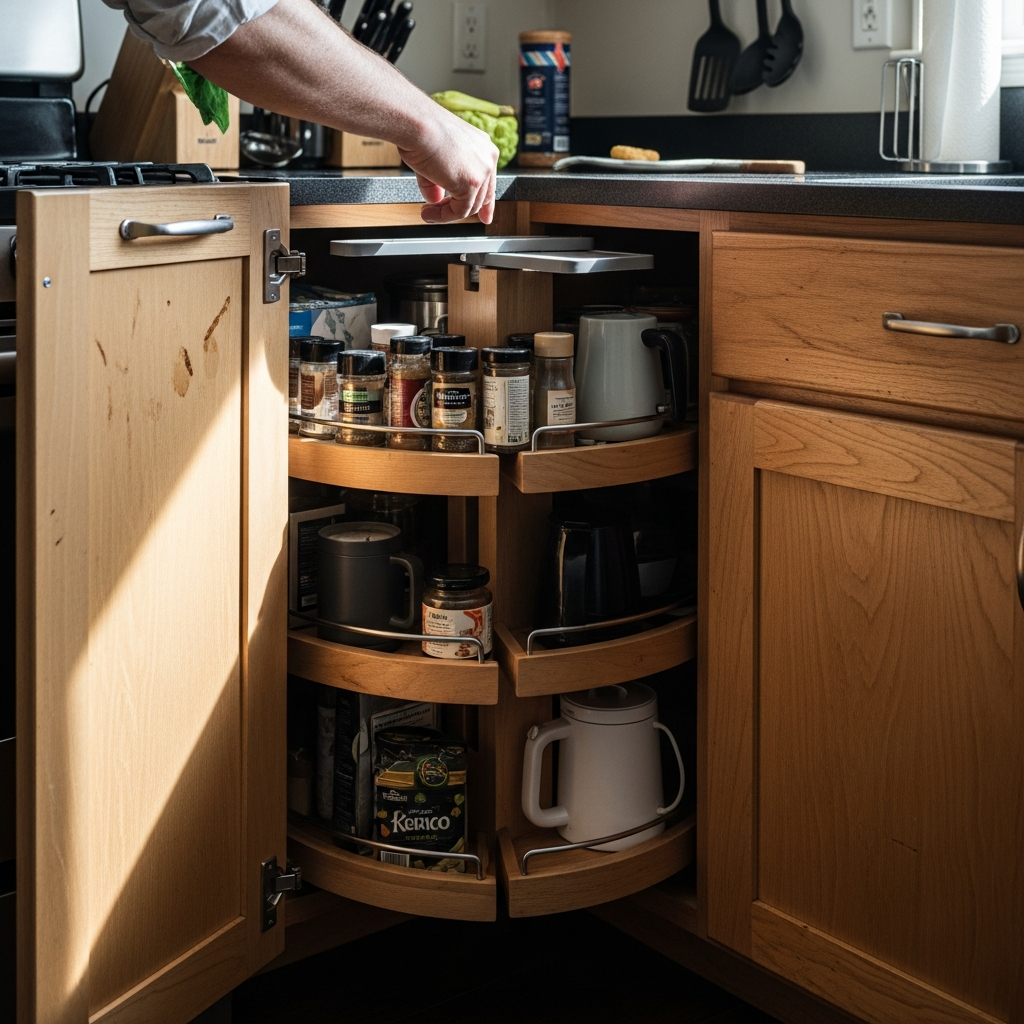
The deep interior of a corner cabinet demands intelligent organization, and this is where I see a lot of builders drop the ball. The cabinet looks great from the outside, but everything shoved in there disappears into the back corner like socks in a dryer. Consider installing a lazy Susan turntable for kitchen applications, pull-out drawer systems for bathrooms, or angled shelves that follow the cabinet geometry.
For a simpler approach that I use on most of my builds, install a single fixed shelf at mid-height and add battery-powered LED strips along the interior edges. Good lighting makes even deep storage accessible and prevents the cabinet from becoming a forgotten dumping ground. The LED strips cost maybe eight bucks and make a huge difference.
Installation Tips
Level the cabinet using shims at the floor — and I promise you, the corner won’t be perfectly square or level. I’ve never seen one that was. Screw through the back panels into wall studs at multiple points, and fill any gaps between cabinet and walls with trim pieces cut to match the face frame material. Caulk where trim meets wall, but not where trim meets cabinet — wood moves, and caulk on a wood joint will crack by next winter.
A well-built corner cabinet adds 4-6 cubic feet of usable storage from space that previously contributed nothing to the room. Master this technique once, and I guarantee you’ll start seeing corner opportunities in every room you walk into. It’s kind of a curse, actually.


Stay in the loop
Get the latest artisan furniture makers updates delivered to your inbox.