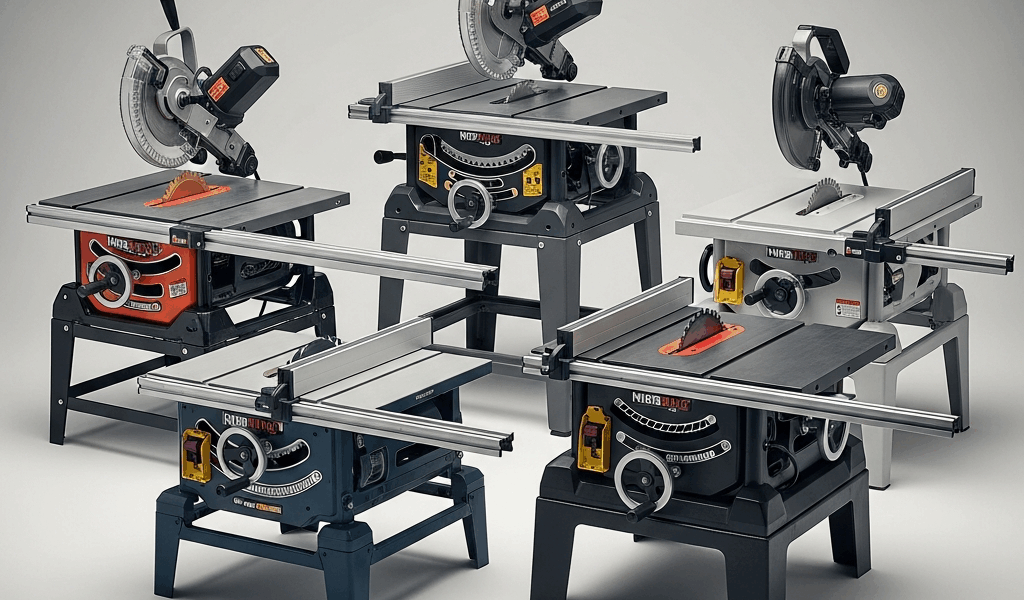
Best Hybrid Table Saw for Small Shop — 5 Models Compared
Finding the best hybrid table saw for a small shop is genuinely harder than it sounds, and I say that as someone who spent three years running a one-car garage furniture operation before moving into a proper 400-square-foot dedicated workshop. I’ve owned a contractor saw, briefly flirted with a cabinet saw that nearly ate my entire floor plan, and landed on a hybrid as the obvious middle ground. The problem is there are dozens of them, the spec sheets all sound identical, and the reviews online are mostly written by people who’ve never actually tried to rip an 8-foot board in a space where they also store their lumber, their finishing supplies, and a workbench. This article is my honest attempt to fix that.
What Makes a Hybrid Saw Right for a Small Shop
Let’s get the terminology straight first, because “hybrid table saw” gets used loosely. A true hybrid combines a contractor-style motor mounted inside a cabinet — like a cabinet saw — but runs on standard household power and sits in a lighter, less massive enclosure. You get better dust collection and fence quality than a contractor saw, without the 600-pound footprint and 240V dedicated circuit that a full cabinet saw demands. For a small shop, that trade-off is the whole ballgame.
The 110V vs 220V Question
This is the first thing I ask anyone who’s shopping for a saw. What’s your electrical situation? Most hybrid saws ship in a 110V configuration but can be rewired for 220V. Running them on 110V is completely workable for furniture-scale hardwood cuts, but you’ll notice the motor laboring in dense stock like hard maple or 8/4 walnut. Rewiring to 220V — assuming you have a circuit or can add one — gives you noticeably smoother cuts and reduces the risk of nuisance trips on your breaker. I fried a breaker twice before I finally ran a dedicated 20-amp 110V circuit, and even that only partially solved the problem. Eventually I paid an electrician $280 to drop a 220V line, and I haven’t thought about the motor since.
If you’re renting your space or working in a garage attached to a house with an older panel, 220V may not be realistic. It’s not a dealbreaker, but know that going in.
Space Constraints — The Real Numbers
A hybrid table saw’s listed footprint is almost a lie. The saw itself might be 27 inches deep and 22 inches wide. But the working footprint — the space you actually need to safely operate it — is something else entirely. You need outfeed clearance equal to the length of your longest workpiece, infeed clearance to match, and side clearance for ripping sheet goods. In practice, that means a saw positioned in the center of a 12×12 room eats almost the whole room. I’ve seen people try to solve this by pushing the saw against a wall and using a roller stand for outfeed. That works. It’s not elegant, but it works.
Most hybrids have a footprint roughly in the 27″ x 22″ range for the cabinet itself. Add the extension table and you’re typically looking at 52 to 60 inches of total width. Plan around that number, not the cabinet alone.
Dust Collection in a Small Space
This matters more than people admit, especially in a residential or attached-garage shop where dust migrating into living spaces is a real concern. Cabinet saws have fully enclosed bases that connect directly to a 4-inch dust port, and they capture 80–90% of the dust at the blade. Contractor saws are famously bad — the open base lets dust blow everywhere. Hybrid saws are in between, but the better ones have a nearly enclosed cabinet with a 4-inch port that connects to a shop vac or small dust collector. The SawStop hybrid and the Powermatic PM1000 both do this well. The Grizzly G0771Z is decent but requires a bit of extra sealing with foam tape to get serious capture efficiency.
Noise is the other residential shop issue nobody talks about. A hybrid running at full load in a detached shop at 8am is one thing. In an attached garage at 7pm with neighbors 20 feet away, it’s a conversation you don’t want to have. Hybrids are louder than a track saw and quieter than a large cabinet saw — roughly 95–100 dB at the operator position. Hearing protection is non-negotiable regardless.
5 Hybrid Table Saws Ranked for Small Shops
Probably should have opened with this section, honestly. Here are five saws I’ve either owned, used extensively at other shops, or researched thoroughly enough to have an informed opinion. Each one has a legitimate case to make for small shop work.
1 — SawStop PCS175-TGP236 (1.75 HP Professional Cabinet Saw)
Yes, SawStop markets this as a cabinet saw, but the 1.75 HP version runs on 110V, weighs 280 pounds, and has a footprint and price point that put it squarely in hybrid territory for small-shop buyers. The 36-inch T-Glide fence is flat-out excellent. Rip capacity with the 36-inch fence is 30 inches to the right of the blade, which handles sheet goods without gymnastics. The cabinet is nearly fully enclosed and connects to a 4-inch dust port — dust collection is the best in this comparison by a meaningful margin.
The flesh-detection brake system is genuinely useful in a small shop where you’re often working tired, working alone, and working in tight quarters. I know one furniture maker who lost a fingertip on a contractor saw and switched to SawStop immediately. He describes it as the best $2,000 he ever spent. Current street price runs around $2,199–$2,499 depending on fence configuration and where you buy. The brake cartridges run about $80 and need replacing after activation — or annually as a precaution if you’re cutting wet or treated lumber regularly. That’s the one real ongoing cost.
The 1.75 HP motor on 110V will work hard in heavy stock. Upgrade to the 3 HP version if you can swing 220V and the budget — but for a small shop running mostly 4/4 and 8/4 hardwood, the 1.75 HP handles it.
2 — Powermatic PM1000 (1.75 HP)
Stumped by the SawStop’s price but still wanting a serious machine, a lot of shop owners land here. The PM1000 lists at around $1,699 with the 30-inch Accu-Fence and typically goes on sale. It’s a proper hybrid — belt-driven, enclosed cabinet, 1.75 HP motor wired for 110V but convertible to 220V. The Accu-Fence isn’t quite at the T-Glide level but it’s solid and locks repeatably. Cast iron table is flat. Trunnion adjustments are accessible from the front, which matters in a small shop where you’re not crawling underneath.
Dust collection is good through the 4-inch port. The cabinet has a brush seal at the blade opening that helps. I’ve run one of these connected to a 1.5 HP dust collector and the shop stayed remarkably clean during a full day of ripping cherry. The PM1000 weighs about 265 pounds, which puts it in the realm of manageable with two people and a furniture dolly. Cabinet dimensions are approximately 22″ deep x 22″ wide before extension tables.
The one thing I’d call out honestly — the miter gauge that ships with the PM1000 is mediocre. Budget $75–$150 for an Incra or Kreg replacement and you’ll be much happier.
3 — Grizzly G0771Z (2 HP Hybrid)
Grizzly built a loyal following in small shops specifically because they price aggressively and ship direct. The G0771Z runs about $1,095 currently, which is dramatically less than the SawStop or Powermatic. For that price you get a 2 HP motor (wired 110V, convertible to 220V), a 30-inch rip capacity, and a cabinet that’s reasonably well enclosed. The T-square style fence is better than it has any right to be at this price point.
Frustrated by mediocre dust collection out of the box, I watched a Grizzly owner on a woodworking forum seal the cabinet seams with self-adhesive foam weatherstripping and improve capture efficiency by a noticeable amount. It costs $8 and 20 minutes. Worth doing. The cast iron table on the G0771Z flattens out after a few uses and holds alignment well — Grizzly has improved their quality control meaningfully over the past decade.
The honest downside is customer service. Grizzly’s support is phone-and-email only, response times vary, and replacement parts ship from their Muncy, Pennsylvania or Springfield, Missouri warehouses, which means lead times if something breaks. For a production shop that can’t afford downtime, this might be disqualifying. For a weekend artisan who can wait a week for a part, it’s a non-issue.
4 — Jet JBTS-10MJS (10″ Jobsite Table Saw — Worth Mentioning)
Wait — this isn’t a hybrid. But I’m including it as a comparison point because I know a lot of small-shop people who’ve asked me whether a premium jobsite saw is a real alternative. Short answer: for very small spaces under 200 square feet, the Jet JBTS-10MJS at around $649 is worth considering as a primary saw. It has a 15-amp motor, folds compactly, and has a shockingly good fence. Dust collection is poor. It will not replace a proper hybrid for heavy production. But if your constraint is truly severe and a hybrid’s 280-pound cabinet isn’t going to fit, don’t ignore this category.
That said, every furniture maker I know who started on a jobsite saw eventually upgraded. The fence systems and rip capacities just aren’t there for serious work.
5 — Harvey Primus Hybrid Table Saw (1.75 HP)
Harvey is a newer name to a lot of American woodworkers but they’ve been manufacturing in China under OEM contracts for major brands for decades. Their Primus hybrid runs about $1,699, which puts it in direct Powermatic PM1000 territory. The fence on the Harvey is genuinely excellent — some reviewers argue it rivals the T-Glide. The enclosed cabinet has a 4-inch dust port and does a good job capturing below-the-table dust. Motor is 1.75 HP, 110V convertible to 220V.
What sets the Harvey apart is the mobile base integration. The Primus was designed with a matching Harvey mobile base that locks crisply and rolls smoothly on concrete. In a small shop where the saw has to move to allow other operations, this is a real functional advantage. The base runs about $199 separately. Combined with the saw at $1,699, you’re at $1,900 for a highly maneuverable setup with a great fence — that’s a strong value argument against the SawStop if the flesh-detection system isn’t a priority for you.
The Harvey’s one genuine weakness is brand newness in the American market. Parts availability and long-term support are unknowns. I’ve been running the Primus for about 14 months without a single issue, but I’m honest with people that it’s a younger track record than Powermatic or Grizzly.
Setup and Space Planning Tips
Getting the saw into the shop is one thing. Setting it up so it actually functions in a small space without making every other operation miserable is the harder problem. I’ve made a lot of mistakes here and I’ll give you the ones that cost me the most time to figure out.
Outfeed — Solve This Before You Buy
Your outfeed solution determines your saw position, which determines your entire shop layout. The three realistic options in a small shop are: a fixed outfeed table attached to the saw (adds 24–36 inches of depth permanently), a folding outfeed table on a hinge bracket (stores vertical when not in use, brilliant for small spaces), or a roller stand positioned temporarily behind the saw for long cuts. I built a folding outfeed table from 3/4-inch plywood and a pair of $14 piano hinges from the hardware store. It folds flat against the back of the saw cabinet, held by a simple hook-and-eye latch. When I need it, it’s down in 10 seconds. That single shop solution probably saved me 40 square feet of permanent floor space.
Minimum Clearances for Real Work
The numbers I work with: 36 inches from the blade to any wall or obstruction on the infeed side. 8 feet of clear outfeed for ripping standard lumber. 36 inches of clearance on the fence side for sheet goods (more is better). On the non-fence side, 18 inches minimum — you need to reach the blade guard and make bevel adjustments. These aren’t generous estimates. They’re the numbers where you can actually work without constant frustration. If you can’t hit all four, prioritize outfeed first, fence side second.
Mobile Bases — Not Optional in a Small Shop
Every hybrid saw I’d consider buying for a small shop should be on a mobile base. Period. The ability to roll the saw back 18 inches when you’re hand planing, assembly, or finishing changes the whole dynamic of a small shop. Bora makes a solid universal mobile base in the $70–$85 range that fits most hybrid saws. Harvey sells their branded base for their own saw. SawStop sells a matching base for the PCS series at around $180. The SawStop base is overbuilt in the best possible way — four locks, heavy casters, smooth on concrete and on rubber mat. Worth the premium if you’re buying the SawStop.
Positioned correctly on a mobile base, a 280-pound hybrid saw becomes something you can move alone in about 30 seconds. That changes what’s possible in a 400-square-foot shop dramatically.
Dust Collection Hookup — Match the Port
All five saws in this comparison use a 4-inch dust port. A small dust collector in the 1–1.5 HP range — the Jet DC-1100A at around $299 is a solid choice — handles this port well and keeps a small shop genuinely clean. Running a shop vac works in a pinch but shop vacs fill fast and have to be emptied constantly during heavy use. If I were starting over, I’d buy the dust collector before I bought a second tool. The air quality in a small enclosed shop without proper dust collection isn’t just a mess issue. It’s a health issue, and a serious one.
One last thing worth saying plainly: the best hybrid table saw for your small shop is the one that fits your actual space, your actual electrical situation, and your actual budget — not the one with the most impressive spec sheet. The SawStop is the best saw in this comparison. The Grizzly is the best value. The Harvey is the most space-smart. Pick the one that matches your constraints and get back to making furniture.


Stay in the loop
Get the latest artisan furniture makers updates delivered to your inbox.