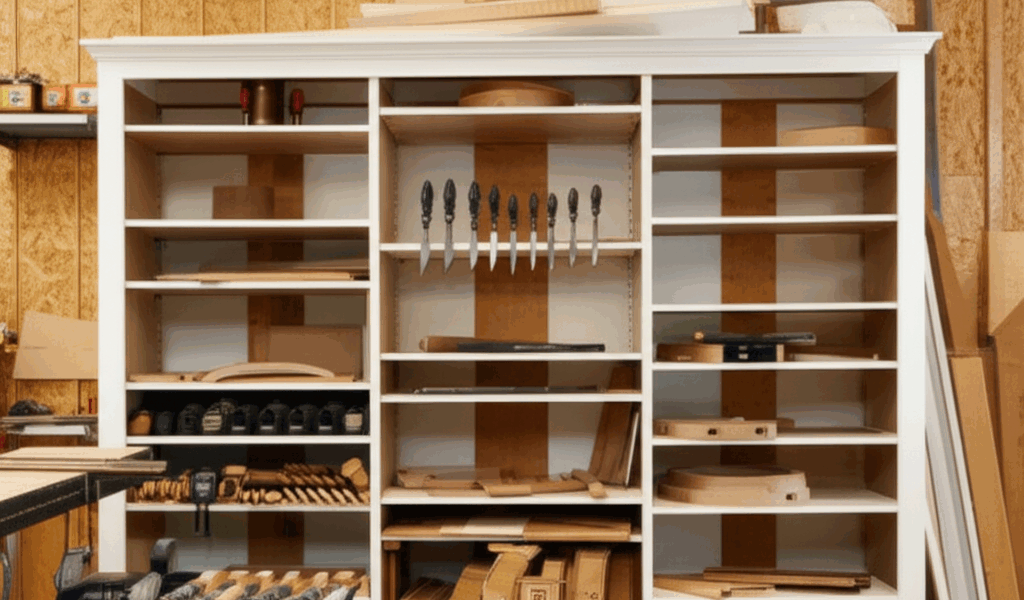
Walk-in closet built-ins have gotten complicated with all the fancy systems flying around at container stores. As someone who built custom closets in three different houses before figuring out what actually works, I learned everything there is to know about maximizing closet space the hard way. Today, I will share it all with you.
Real estate agents know something most homeowners don’t: walk-in closet built-ins consistently return more than their cost in home value. Install $800 worth of lumber and hardware over a weekend, and your home’s appraised value increases by $4,000-5,000. No other improvement offers this return on investment.
Beyond the numbers, custom built-ins transform awkward closet spaces into organized systems that make daily life measurably better. That’s what makes this project endearing to us weekend woodworkers—it combines practical skill-building with immediate, visible results.
What We’re Building
This project outfits a standard 8 by 6 foot walk-in closet with double-hang sections for shirts and pants, full-length hanging for dresses and coats, open shelving for folded items, and drawer storage for accessories. Total material cost runs $700-900 depending on your finish choices.
Probably should have led with this: you don’t need fancy tools. A circular saw, drill driver, level, and measuring tape handle everything. The skills are straightforward if you take your time with measurements.
Planning and Measurement
Start by measuring the closet precisely, noting any irregularities in wall squareness, floor level, and ceiling height. Older houses are rarely perfectly square—mine was off by nearly an inch across eight feet. Discovering this after cutting all your pieces is expensive.
Draw the space to scale on graph paper or in a simple CAD program. This drawing becomes your cut list source and prevents costly errors. I use SketchUp for this, but paper and pencil work fine if you’re comfortable with basic drafting.
Standard dimensions guide the layout: hanging rods at 42 inches from the floor for double-hang (with the upper rod at 84 inches), 66 inches for full-length hanging, shelves at 12 inches deep for most items, and 16 inches deep for bulky sweaters. Drawer heights typically run 6, 8, and 10 inches for ascending storage tiers.
Material Selection
Melamine-coated particle board offers the most economical option, with factory-finished surfaces that need no painting. It’s available in white, almond, and various wood-grain patterns. The downside: melamine chips easily during cutting and doesn’t hold screws as well as plywood. Pre-drill everything.
For superior durability, use 3/4-inch hardwood plywood with pre-applied edge banding. This costs roughly twice as much as melamine but lasts indefinitely and handles fasteners reliably. Prime and paint all surfaces before installation for a factory-finished appearance that rivals commercial systems.
I’ve built with both materials. For a house I planned to sell, melamine made sense. For our forever home, I used birch plywood and don’t regret the extra cost. Match material to context.
Vertical Partition Construction
Build the system around floor-to-ceiling vertical partitions that divide the closet into functional zones. Cut these from full sheets of 3/4-inch material, with a 4-inch notch at the floor to clear baseboard molding. Partitions typically stand at 24-inch intervals to create standard cabinet-width openings.
Secure partitions to the back wall using a French cleat system—a beveled strip at the top locks the partition to a matching wall-mounted cleat. This provides tremendous holding power while allowing adjustment during installation. Add a toe kick board at the floor and a crown shelf at the top for a fully finished appearance.
Take your time getting partitions plumb. An out-of-plumb partition means nothing else will line up correctly. Use shims generously and check with a level from multiple angles.
Hanging Rod Installation
Chrome oval closet rods provide the most capacity, supporting heavy winter coats without sagging across typical spans. Use rod cups rated for your span—typically a center support is needed for any run over 48 inches. I learned this lesson when a fully-loaded rod bowed enough to pull clothing off hangers at the center.
Position rod cups 12 inches from the back wall. This depth centers clothing on the rod while providing clearance for hangers to rotate freely. Attach cups using screws driven into solid wood backing or wall studs; never trust drywall anchors for the weight of a full wardrobe. Anchors fail, usually at the worst possible time.
Shelf and Drawer Systems
Fixed shelves attach to partitions using shelf standards and brackets, or with simple cleats screwed to partition faces. Adjustable systems offer more flexibility—install shelf standards vertically and cut shelves to drop into place on adjustable brackets. I prefer adjustable systems because life changes and storage needs evolve.
For drawer storage, build individual drawer boxes from 1/2-inch plywood with applied fronts that match the partition material. Use full-extension undermount slides for smooth operation and maximum access. A bank of four or five drawers provides exceptional small-item organization that open shelving can’t match.
Don’t cheap out on drawer slides. Budget slides bind, sag, and fail. Quality full-extension slides cost maybe $15 more per drawer and last decades. Worth every penny.
Lighting Integration
Good lighting transforms closet functionality—and most builders skip this entirely. LED strip lights mounted under shelves illuminate lower zones that would otherwise stay dark. Puck lights or continuous LED strips on the ceiling provide general illumination.
Wire lights to a door-activated switch for automatic operation. Walking into a lit closet versus fumbling for a switch while holding an armful of clothes is the kind of quality-of-life improvement that costs almost nothing but feels luxurious.
Installation Sequence
Order matters here. Install back wall cleats first, verifying level and stud locations. Mount vertical partitions next, shimming as needed to achieve plumb. Add horizontal shelves and rod supports, then hanging rods. Install drawer boxes last, adjusting slides for smooth operation after everything else is locked in place.
Fill any gaps between partitions and walls with trim molding—scribe cuts look professional but aren’t always possible. Caulk along wall and floor intersections for a seamless built-in appearance that makes the installation look like it came with the house.
The Bottom Line
Two focused days of work transforms a basic closet into a luxury organizing system. The tools required are basic. The skills are straightforward: accurate cuts, plumb installation, and patience with adjustment. The return—both in home value and daily convenience—makes this project one of the best investments any homeowner-woodworker can make.
Start planning your layout this weekend. Measure twice. Then transform that wasted closet space into something that actually works.