
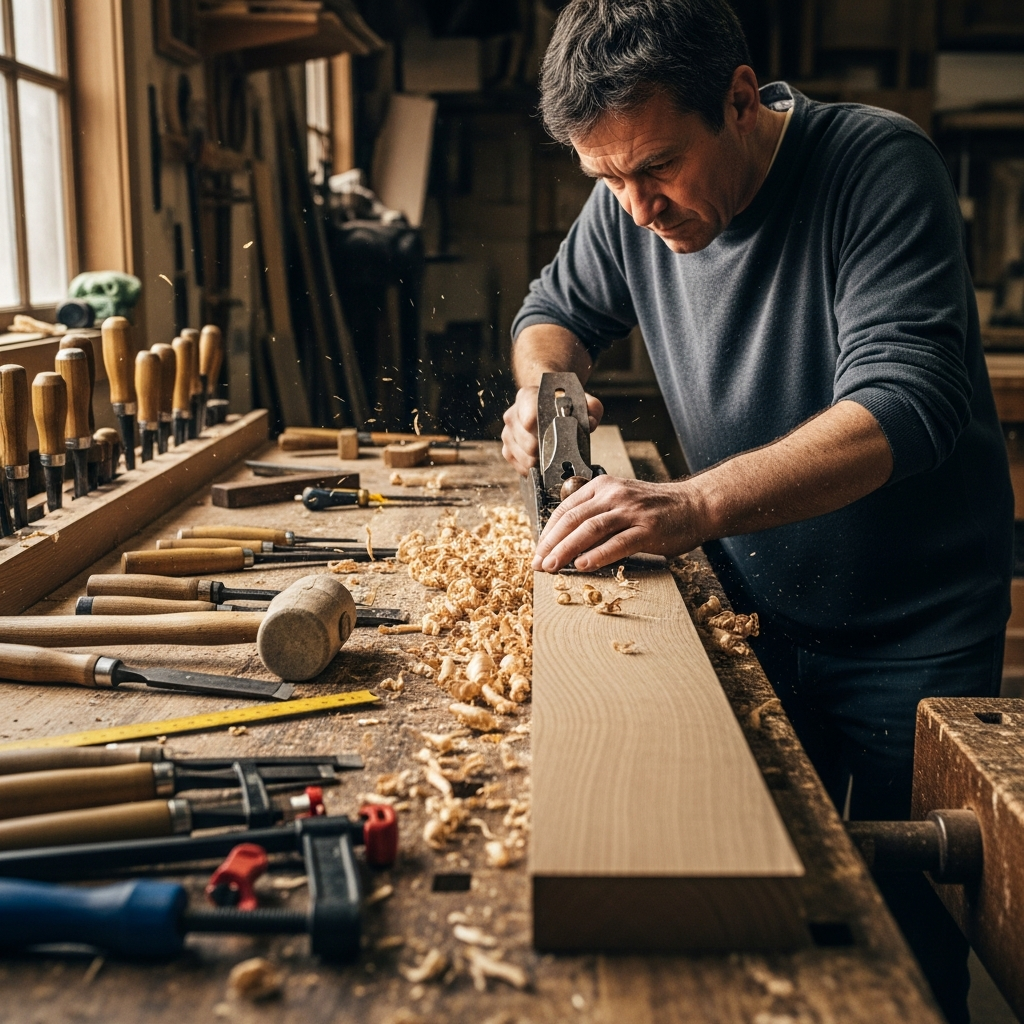
Dado Blades – The Tool That Changed How I Build Furniture
I spent years making dadoes the old-fashioned way. Multiple passes with a regular blade, chisel work to clean up, lots of swearing. Then someone at my woodworking club basically staged an intervention and made me buy a proper dado set.
Changed everything. Honestly wish I had done it sooner.
What a Dado Blade Actually Does
For those who are newer to this – a dado is basically a channel or groove cut across the grain of a board. They are everywhere in furniture: the slots where shelves sit in a bookcase, the grooves for drawer bottoms, anywhere you want to join pieces in a strong, clean way.
A regular saw blade is thin and cuts a thin kerf. A dado blade is wide – you set it up to cut grooves typically from 1/4 inch to 3/4 inch wide in a single pass. The difference in speed and accuracy is ridiculous.
Stacked vs Wobble – Learned This One the Hard Way
There are two types and they are not remotely equal.
Stacked dado sets have two outer blades (like regular saw blades) and a bunch of chipper blades that go between them. You add or remove chippers to get exactly the width you need. The cuts are clean, the bottom is flat, and everything works the way it should.
Wobble dado blades are a single blade mounted on an angled hub that makes it wobble side to side as it spins. They are cheaper, but the cuts have a slight curve at the bottom and the whole thing just feels sketchy to me. I tried one, hated it, sold it at a loss.
Spend the extra money on a stacked set. Seriously.
Setting One Up Without Destroying Anything
The first time I used my dado set I nearly ruined a table top because I did not understand a few basic things:
You need a zero-clearance insert for your table saw. The regular throat plate has a slot sized for a thin blade. A dado set is way wider and the wood will dive into that gap and probably take your fingers with it. Make a zero-clearance insert or buy one. Not optional.
Measure twice, set up once. Getting the exact width you need takes some trial and error. Use scrap wood that is the same thickness as your real material. Make test cuts until it is perfect.
Do not rush the feed rate. A dado blade is removing a lot more material than a regular blade. Push too fast and you get burning, tearout, or a stalled motor. Nice and steady.
What I Actually Use It For
Honestly, once you have a dado set you start seeing applications everywhere:
Shelving. Dadoes make shelves rock solid. The shelf sits in a groove on both sides so it can not move. No visible fasteners, clean look, strong as hell. This alone justified the purchase for me.
Drawer construction. Grooves for the bottom panel, dadoes for the back, rabbets for the front. The dado set does all of it. My drawers got so much better once I started using proper joinery instead of just nailing stuff together.
Cabinet face frames. Cutting rabbets for the back panel, grooves for dividers – fast and accurate.
Box joints. With a simple jig you can cut box joints (finger joints) that are both decorative and incredibly strong. I use these on jewelry boxes and small chests. People always comment on how professional they look.
Safety Stuff That Matters
Table saws are dangerous. Dado blades are more dangerous because they are removing more material and producing more force. Pay attention:
Use the blade guard when possible. Yeah, it is annoying sometimes and there are cuts where you need to remove it. But use it when you can.
Push sticks are your friend. Your fingers do not go anywhere near that blade. Ever. I have all ten still and I am keeping them.
Let the blade come to a complete stop before reaching anywhere near it. Dado sets have a lot of mass and take longer to coast down than regular blades.
Brands I Have Tried
Freud is what I am running now. The cuts are consistently clean, the chipper teeth line up well with the outer blades, and the anti-kickback design gives me some peace of mind. Not cheap but worth it.
DeWalt I have used at a friend’s shop. Similar quality to the Freud, maybe slightly easier to set up. Good choice.
Forrest is supposed to be the gold standard but I have never actually used one. At those prices it better make breakfast too.
Avoid the no-name bargain sets. The chippers often do not align properly with the outer blades and you get ridges in the bottom of your cut. Frustrating and not worth saving fifty bucks.
Maintenance
These things stay sharp for a long time if you treat them right. Clean off pitch buildup with some blade cleaner after heavy use. Store them in the case they came in so the teeth do not get banged up.
When they finally do get dull, sharpen do not replace. A good sharpening service will have them cutting like new for a fraction of the replacement cost.
Bottom Line
If you are doing any kind of furniture building or cabinet making, a dado set is not optional equipment. The speed increase alone is worth it, but the improvement in joint quality is what really matters.
Get a stacked set from a reputable brand, make yourself a zero-clearance insert, and practice on scrap until you are comfortable. Your projects will level up immediately.
Trust me on this one – it is the upgrade I wish I had made years earlier.


Stay in the loop
Get the latest wildlife research and conservation news delivered to your inbox.