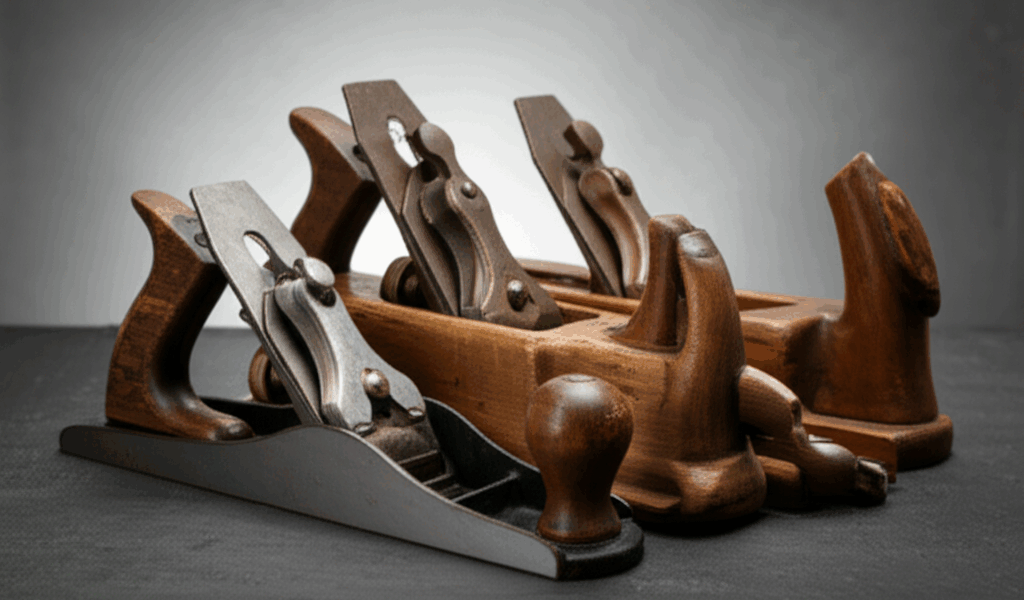
Found a box of my grandfather hand planes in the garage. Four Stanley Bailey planes from the 40s. A bit rusty but the irons are good.
Spent the morning cleaning and sharpening. The number 4 takes a shaving so thin you can read through it now.
They do not make them like this anymore. Literally. These have more steel in the sole than modern imports have in the whole plane.
I have been looking for these for thirty years. Not actively looking – more like wondering whatever happened to them. Grandpa died in 94, and I was too young to think about claiming his tools. The house got emptied, the estate got settled, and I always assumed his workshop stuff went to Goodwill or the dump.
The Discovery
My parents are cleaning out their garage. They are getting older, thinking about downsizing, and there is forty years of accumulated stuff in that two-car garage. Mom asked if I would haul away some old rusty tools she found behind the freezer.
I almost sent my son to do it. Almost.
Walked in, and there is a wooden apple crate with Bailey stenciled on the side. My heart stopped. Pulled off the newspaper on top – dated March 1994, so this has been sitting here since right after Grandpa passed – and there they were. Four hand planes, a Stanley brace drill, a full set of auger bits, and a dovetail saw so fine it looked like it had never been used.
Mom said Grandpa told her to keep these for Jason before he went into the hospital. She put them in the garage meaning to give them to me. Then forgot. For thirty years.
The Planes
Let me tell you what was in that box.
Stanley Bailey No. 4 Smoothing Plane, Type 11. That dates it to 1910-1918. The oldest of the bunch and the one Grandpa used most. The handles are worn smooth from decades of hands. The rosewood knob is cracked but solid. The sole has a patina so deep it looks almost bronze.
Stanley Bailey No. 5 Jack Plane, Type 16. Made between 1933 and 1941. This is the workhorse, used for flattening stock before the smoothers touch it. The lateral adjustment lever is sticky but functional.
Stanley Bailey No. 6 Fore Plane, Type 15. Early 1930s. An 18-inch sole for jointing edges. I have been using a modern Woodriver for this task, but after cleaning this one up, the Woodriver is going on the shelf.
Stanley Bailey No. 7 Jointer Plane, Type 16. The king of the bench planes. Twenty-two inches of cast iron and a blade you could shave with. Literally – Grandpa used to joke about using it as a razor when he ran out of Gillettes.
The Restoration
The planes had surface rust but nothing deep. I soaked them in Evaporust overnight – a chemical rust remover that works like magic without damaging the steel. By morning, the rust was gone and I could see the original machining marks on the soles.
The irons were in better shape than I expected. Grandpa always oiled his tools before putting them away, and that oil had protected the cutting edges. A few sessions on my waterstones – nothing aggressive, just honing – and they were taking shavings again.
The most tedious part was flattening the soles. Even vintage Stanleys can warp over decades, and you need a dead-flat sole for precision work. I used a granite surface plate with adhesive sandpaper – 80 grit to start, working up to 220. About forty minutes per plane, checking with a straightedge constantly. The No. 4 was nearly perfect. The No. 7 had a very slight hollow in the center that took some work to correct.
The First Test
I grabbed a piece of scrap cherry and locked the No. 4 in for its first real work in thirty years.
The shaving came off in one continuous ribbon, maybe three thousandths of an inch thick. You could read newspaper through it. The surface it left was so smooth I could see my reflection in the wood before any finish. That is what people mean when they talk about hand-planed surfaces – there is a quality to them that sandpaper will never achieve.
I might have teared up a little. Do not tell anyone.
What They Are Worth
Monetarily? A Type 11 Stanley No. 4 in this condition goes for 150 to 200 dollars on eBay. The Type 16 No. 7 jointer, maybe 250 dollars. Altogether, maybe 700 dollars if I wanted to sell them.
But I do not want to sell them. Ever.
These planes will be in my shop until I die, and then my daughter will get them. She is twelve and already knows how to sharpen a chisel. By the time she is old enough to appreciate what these mean, she will have learned how to use them properly.
Some tools are just tools. These are heritage.
Thanks, Grandpa. Thirty years late, but I finally got your message.