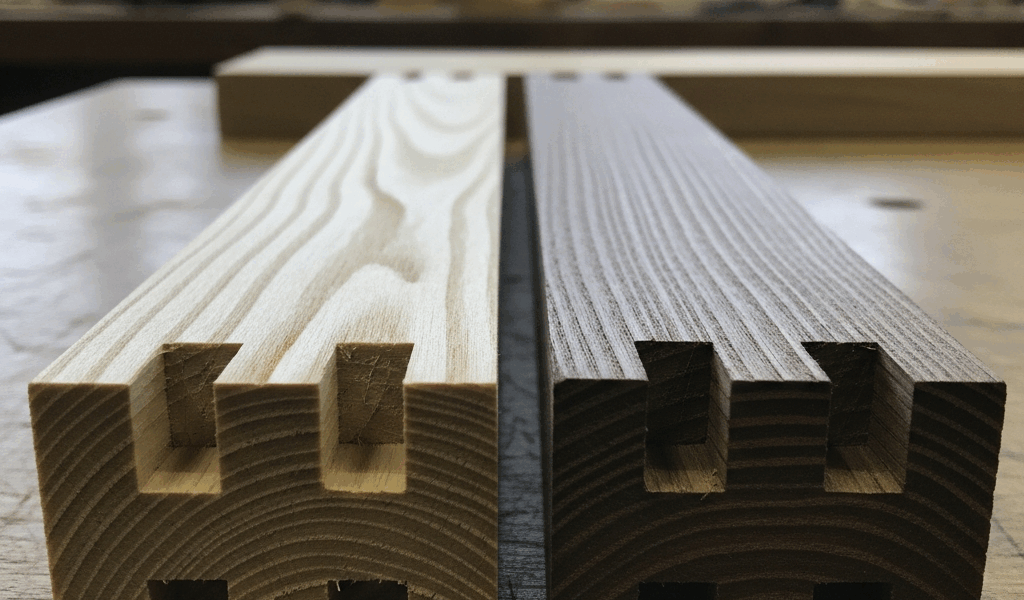
Hand Cut Dovetails vs Router Jig Dovetails
What You Are Actually Comparing
The hand cut dovetails vs router jig dovetails debate has gotten complicated with all the romantic nostalgia and dismissive practicality flying around. As someone who spent a humbling year cutting joints by hand before eventually dropping $380 on a Leigh D4R Pro, I learned everything there is to know about both sides of this argument. Today, I will share it all with you.
But what is each method, really? In essence, hand cut dovetails are a marking gauge, a quality dovetail saw, a coping saw for waste removal, and a set of chisels — that’s your entire toolkit. You lay out your pins or tails by hand, saw to the line, chop the waste, transfer the pattern to the mating board. No templates. No electricity. Router jig dovetails are a different animal entirely — a fixed aluminum template like the Porter-Cable 4216 or the Leigh D4R, paired with a router running a half-inch carbide dovetail bit at a 14-degree angle. The template controls everything. But it’s much more than just a speed difference between the two.
What they are not is interchangeable — not in what they demand from you, not in what they give back.
Time and Skill Investment Per Drawer Box
So, without further ado, let’s dive in with actual numbers instead of vague gestures.
Hand cutting a set of dovetails for a single drawer box — four corners, eight-inch wide poplar sides, half-inch pins — took me around 75 minutes when I was starting out. That includes layout, sawing, chopping, fitting, and the inevitable re-fitting after cutting something a hair too aggressive. With consistent practice over six to twelve months, most woodworkers get that number down to 20 or 30 minutes per box. Some experienced makers go faster. The key word is consistent. Take three weeks off and you come back slower than you left — sometimes noticeably so.
Router jig times look completely different. The actual routing on a dialed-in jig takes 15 to 20 minutes per box, sometimes less. But that number is misleading. Setup and test cuts on scrap to nail your bit depth can add another 30 to 45 minutes the first several sessions. The Porter-Cable 4216 manual is — honestly — not exactly a pleasure to read. Once you have a setup sheet written down for your specific material thickness, that 15-minute mark becomes reliable on production runs.
The shape of the learning curve is the real difference here. Jig proficiency plateaus fast — most people are producing acceptable joints within a weekend. Hand cutting keeps improving for years. You get faster, tighter fits, better intuition about grain direction and how different woods behave under a chisel. That’s what makes hand cutting endearing to us hand-tool woodworkers. If you need good joints by Tuesday, though, the jig gets you there without apology.
How Each Joint Looks After Finish
Probably should have opened with this section, honestly, because for a lot of furniture makers this is the deciding question — not strength, not time, but how the thing looks when someone picks it up.
Router jig dovetails are uniform. Every pin is the same width, every tail is the same angle, every half-pin at the corner is identical. Under a clear oil finish on quartersawn white oak, that uniformity reads as machined. Not ugly — precise and clean. But it does not read as handmade. Experienced buyers notice. On a painted piece, a kitchen cabinet drawer box, a utility chest — nobody can tell the difference and it genuinely does not matter. Don’t make my mistake of agonizing over it on painted Shaker cabinets. Nobody is prying those drawers apart to inspect the joinery.
Hand cut dovetails can vary in pin spacing, width, and the subtle asymmetry of layout. A maker who cuts them well develops a personal rhythm — slightly wider baseline pins, maybe five tails instead of four on a wide drawer front — and that variation is exactly what signals handwork under a natural finish. The glue line on a well-fit hand cut joint is nearly invisible. You can cut pins down to an eighth of an inch for a more delicate fine-furniture look that no standard router template produces.
I’m apparently a quartersawn white oak obsessive and hand cut joints work for me there while router templates never quite give me the visual rhythm I want on that species. For cherry and hard maple, both methods look stunning — but cherry is less forgiving under a chisel than poplar or soft maple. Tight grain is beautiful. It also telegraphs every torn fiber. Learn on something forgiving before you practice on a $12-per-board-foot board.
Strength and Longevity in Real Furniture
Short answer: both are strong enough. Stop worrying about this.
A properly glued dovetail joint — hand cut or jig cut — will outlast the furniture around it. The mechanical geometry of interlocking tails and pins resists racking and pulling forces in every direction that matters for a drawer box. There is no residential furniture application where a correctly executed router jig joint fails because it wasn’t hand cut.
The real failure mode for either method is fit. A sloppy hand cut joint with gaps at the glue line is structurally weaker than a tight jig-cut joint — full stop. Gap-filling glue is not a solution. It’s an admission. I learned this rushing a set of cherry drawer boxes in 2019 and watching one corner open up after about fourteen months of use. The glue had nothing to grip. Tight fit first, method second.
One honest note on wood movement: very tight hand-fitted joints in solid wood can occasionally creak in extreme humidity swings if the fit leaves zero room for seasonal movement. Rare problem. Sign of excellent workmanship taken to an edge case. Not a reason to cut sloppily — just worth knowing exists.
Which Method Fits Your Shop Right Now
Here is the honest self-selection guide, without the sermon.
Reach for the router jig if:
- You are building multiple drawer boxes and need consistent results under time pressure
- You are newer to joinery and want functional joints while developing other skills
- Your pieces are painted or the drawer construction won’t be visible in normal use
- You are running a small production operation where labor time directly affects your margins
Reach for hand tools if:
- You are building a piece where visible joinery is part of the design and the price
- You want a skill that transfers — hand cut dovetail proficiency genuinely makes you better at mortise and tenon layout, hand-cut box joints, fitting almost any joint by eye
- You enjoy the process of cutting by hand, because that enjoyment is real and it matters
- You are building something meant to last generations and want every element to reflect that intention
While you won’t need to spend a fortune, you will need a handful of quality tools either way. A solid hand tool starter kit — a Veritas marking gauge at $45, a Lie-Nielsen or Crown dovetail saw around $50 to $75, two or three quality bench chisels — can be assembled for under $150. Those tools last indefinitely. A quality dovetail jig might be the best option if your shop runs production work, as consistent drawer joinery requires repeatable setup. That is because even a skilled hand cutter slows down when cutting identical parts across a twenty-drawer kitchen job. The Leigh D4R Pro runs around $380. The Porter-Cable 4216 runs around $160 — a reasonable entry point to find out if jig work suits your workflow before committing to the higher-end option.
Frustrated by years of takes that forced a false choice, most working furniture makers I know eventually do both — reaching for the jig on production cabinet work, picking up the saw and chisel when the piece calls for it. This new idea of treating them as complementary tools rather than competing philosophies took off several years later in the woodworking community and eventually evolved into the practical shop mentality enthusiasts know and respect today. That is not a compromise. That is a complete shop.




Stay in the loop
Get the latest artisan furniture makers updates delivered to your inbox.