Sharpening day. Spent the morning on the stones. Everything cuts better now.
Should do this weekly. Never do. Always glad when I finally get around to it.
There is something almost meditative about sharpening that I both love and hate. Love because it forces me to slow down. Hate because I always put it off until my chisels are pushing wood instead of cutting it. Today was the day I finally could not ignore it anymore.
The Setup
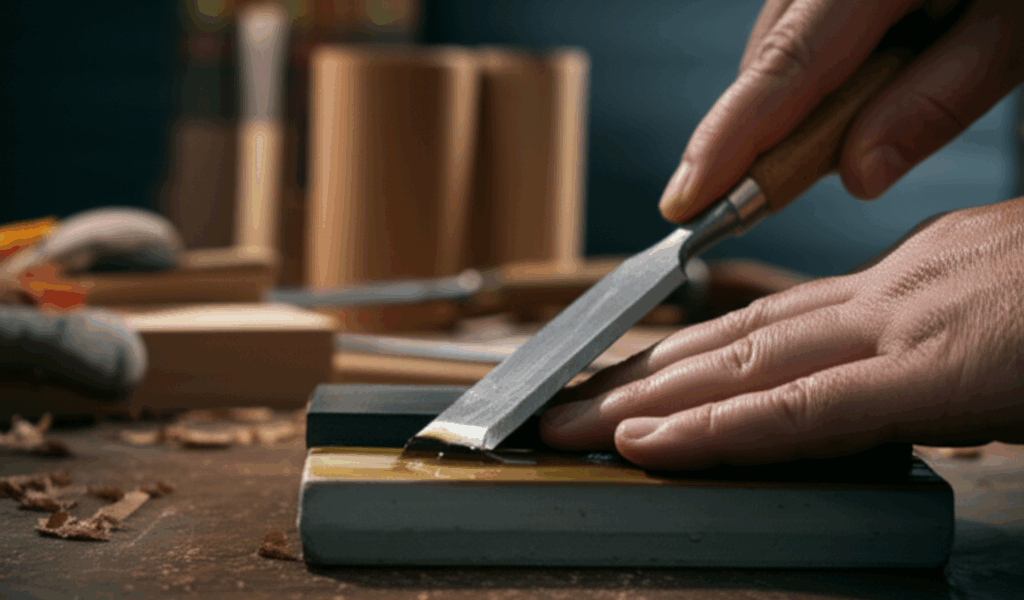
My sharpening station is nothing fancy – a piece of 3/4 inch MDF with some 1×2 cleats to hold my waterstones in place, clamped to the bench. I use a progression of King stones: 1000 grit to establish the bevel, 4000 to refine it, and 8000 for the final polish. Some guys go higher. Some guys use diamond plates. I have tried both and keep coming back to waterstones. There is a feedback you get from them that I cannot explain – you can feel when the edge is forming.
Soaked the stones for about 20 minutes while I had my second cup of coffee. 1000 grit needs at least 10 minutes; the finer stones need longer. Trying to sharpen on a dry waterstone is an exercise in frustration.
The Patient That Needed the Most Work
My 3/4 inch Lie-Nielsen chisel was the worst offender. I had been using it for chopping mortises in white oak last week, and I am not gentle with my mortise chisels. The edge had a visible nick about 1/16 inch in from the corner – probably hit a hidden staple or a mineral deposit in the wood. Either way, it needed serious work.
Started on the 1000 grit stone and just focused on the back first. This is the part most people skip, and it is why their edges never get truly sharp. The back of a chisel needs to be dead flat and polished, at least for the first inch or so behind the edge. I worked it in a figure-eight pattern, checking my progress against a straightedge. Took about 15 minutes to get the scratches from the previous sharpening fully replaced with fresh ones.
Then the bevel. I hold freehand – no honing guide for me, though I am not one of those snobs who thinks guides are cheating. They work fine. I just learned without one and now the muscle memory is locked in. About 25 degrees primary bevel, with a microbevel around 30 degrees at the very edge. Thirty strokes on the 1000, ten on the back. Repeat until I can feel a burr on the back side. That burr tells me I have reached the apex of the edge.
The Rest of the Crew
After the 3/4 inch Lie-Nielsen, I worked through the rest of my bench chisels: 1/4, 3/8, 1/2, 1, and 1-1/4 inch. The smaller ones are vintage Stanley 750s that I picked up at an estate sale years ago. Beautiful tools, but the steel is softer than the Lie-Nielsen, so they need more frequent touch-ups. The larger ones are Narex – great bang for the buck, perfectly functional, if not quite as refined.
Each chisel got the full progression: 1000, 4000, 8000. By the time I hit the 8000, the bevel should look like a mirror. If it does not, I have rushed something.
Then the hand plane irons. My Stanley No. 4 smoother gets the most use, so its blade was due. Same process, but I use a side-clamping honing guide for plane irons because I want that bevel absolutely consistent across the full 2 inch width. Any deviation and you get uneven shavings. I also put a very slight camber on my jack plane iron – high in the center, dropping off at the corners. That is what lets you take aggressive cuts without leaving track marks.
The Test
There is only one real test for a sharp edge: the end grain of a soft wood, maybe pine or poplar. If the chisel pares end grain cleanly, leaving a surface that is almost glossy, you are sharp. If it tears or crumbles, back to the stones.
Every chisel passed. The No. 4 smoother took shavings off end-grain cherry that curled up like wood ribbons. That is the stuff that makes you remember why you got into this craft.
The Promise I Will Not Keep
I told myself, like I do every sharpening day, that I will touch up the edges weekly. Just a few strokes on the 8000 stone to maintain that polish. It takes two minutes per edge. There is no excuse not to do it.
I will be back here in a month, chisels dull, making the same promise again. At least I know myself.
But for today? Everything in the shop cuts like a scalpel. Time to make some sawdust.