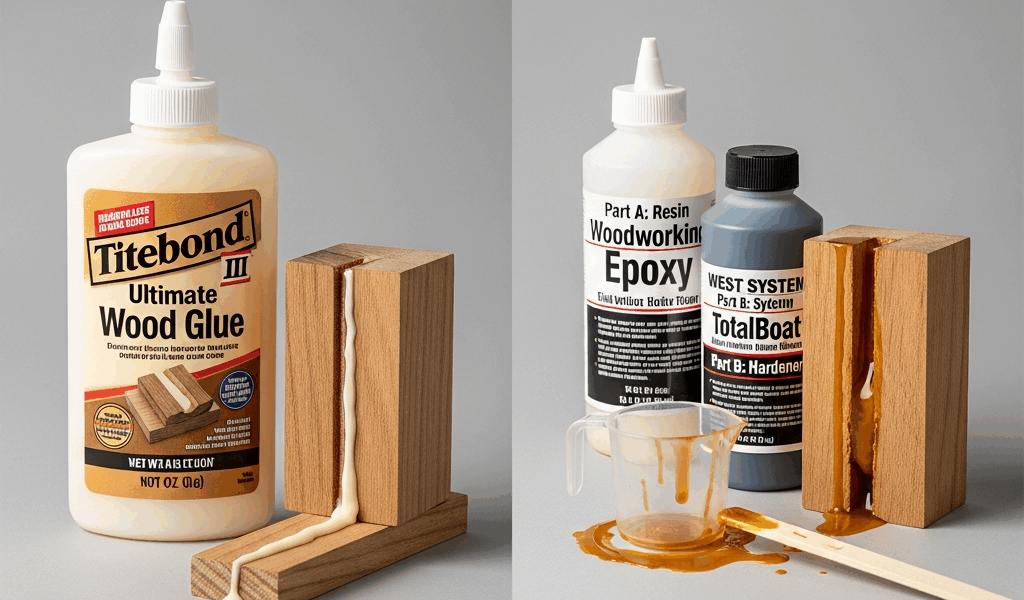
Wood Glue vs Epoxy for Woodworking — When to Use Each
The wood glue vs epoxy woodworking debate comes up constantly in shops, forums, and YouTube comment sections, and most of the answers are frustratingly vague. “It depends” is technically correct but useless when you’re standing at your bench with a joint that needs to close in the next twenty minutes before your clamps are tied up all afternoon. I’ve been building furniture for about twelve years — custom pieces, production runs, repairs on antiques that shouldn’t be touched with anything aggressive — and I’ve developed a pretty clear set of rules for when each adhesive earns its place. Not opinions. Rules, based on what actually holds and what eventually fails.
The short version: PVA glue is your default. Epoxy is your specialist. Using epoxy where wood glue belongs is like using a scalpel to chop vegetables. It’ll work, technically, but you’re making your life harder for no reason.
PVA Wood Glue Wins on Tight Joints
Titebond III is sitting on my bench right now. It has been sitting on my bench, in some form, since I started making furniture. The squeeze bottle gets refilled from a gallon jug I pick up at Woodcraft for around $28, and that jug lasts me a solid two months of regular production. That bottle has closed more joints than I can count, and here’s the thing most woodworkers don’t say plainly enough — on a properly fitted wood-to-wood joint, Titebond III creates a bond that is stronger than the wood surrounding it.
That’s not marketing language. That’s just the chemistry working. When you glue up a well-fitted mortise and tenon, or a flat edge joint on tabletop panels, and you break that joint later, the wood fails before the glue line does. The fiber actually tears apart on either side of the joint while the thin line of cured PVA sits there intact. I’ve done this deliberately with test pieces. It’s consistently true on tight-fitting joints with good surface contact.
What “Tight” Actually Means
Tight means the gap is under 0.005 inches. That’s roughly the thickness of a piece of printer paper. If you can slide a dollar bill into your joint and feel resistance, that’s marginal but workable. If the bill slides freely, you’re entering gap territory and PVA is going to let you down — not immediately, but over time under load.
PVA glues are essentially water-based polymer emulsions. When the water migrates into the wood fibers and the polymer chains cure, you get that mechanical bond that’s genuinely impressive. But that same water-based formula means PVA has almost no gap-filling capability. In a gap, there isn’t enough surface contact for the polymer to grip, and you get what woodworkers call a “starved joint” — brittle, chalky, and destined to open up.
The Creep Issue — and Why It Matters for Furniture
One thing that doesn’t get discussed enough is creep. Creep is slow deformation under sustained load. Some glues creep significantly — original Elmer’s white glue, for instance, will allow a loaded joint to slowly shift over months. Titebond III has excellent creep resistance, which matters enormously on chair joints and table stretchers that live under constant tension. A chair leg that’s under daily load from someone sitting in it needs a glue that doesn’t slowly relax. Titebond III stays put.
Sandability is another practical point. PVA glue sands cleanly. It doesn’t gum up your sandpaper the way cured epoxy does, it doesn’t create hard inclusions that scratch the wood surface around a joint line, and squeeze-out is easy to deal with — either wipe it wet with a damp cloth or let it fully cure and pare it off with a chisel. I prefer the chisel method because wet cleanup can raise grain on adjacent wood surfaces.
Open Time and Working Conditions
Titebond III gives you about eight to ten minutes of open time at 70°F. That’s enough for most glue-ups if you have your clamps staged and your surfaces prepped. In cold weather — below 55°F — PVA glues get sluggish and can fail to cure properly. I’ve ruined a walnut panel glue-up that way in an unheated shop in January. Never again. The minimum application temperature for Titebond III is 47°F, and I’d push that to 55°F as a practical working minimum.
Epoxy Wins on Gaps and Mixed Materials
Probably should have opened with this section, honestly, because gap-filling is the single capability that makes epoxy irreplaceable. When your joint isn’t tight — whether from a machining error, a repair situation, or the inherent complexity of the geometry — epoxy is the only structural-grade option that will fill that gap and hold.
I keep two epoxy systems in my shop. West System 105 resin with 205 hardener is my standard structural epoxy — a quart of resin runs around $45 and the hardener is another $20. For thicker fills and voids, I use System Three SilverTip Gel Magic, which has a thicker viscosity and doesn’t run out of a vertical gap before it cures. Different jobs. Different viscosities.
The Gap-Filling Mechanism
Epoxy is a two-part system — resin and hardener combine in a chemical reaction that produces a cured thermoset polymer. There’s no solvent or water evaporating. The material fills a space, stays there, and hardens in place. That means a 3mm gap gets filled with something that’s actually there, creating real surface contact across the joint.
Surprised by a split in an antique dresser leg, I once repaired a 4mm crack running halfway up a turned maple leg using thinned West System epoxy wicked in with a syringe, followed by a thickened fill of the same system mixed with colloidal silica. The repair has been in service for four years. That crack is not coming back.
The catch — and it’s real — is that on tight wood-to-wood joints, epoxy is actually the weaker choice. Cured epoxy is rigid and somewhat brittle compared to the wood fibers around it. On a tight joint, you’re better served by the mechanical interlock that PVA creates with the wood cells. Epoxy bonds to wood surfaces adhesively, which is fine but not superior. Use epoxy in gaps where it belongs, not as a stronger-seeming substitute for proper fitting.
Wood-to-Metal and Wood-to-Glass
PVA is useless on non-porous materials. Full stop. It needs to penetrate wood fibers to work. Metal, glass, ceramic, stone — PVA won’t bond to any of them. Epoxy will. This comes up in furniture making more than you’d expect: attaching metal legs to wood tops, installing glass panels into frames with minimal mechanical retention, embedding threaded inserts in wood. These are epoxy jobs. The bond strength on a properly prepared metal-to-wood joint with West System is excellent — well above what most furniture applications will ever demand.
Surface prep matters enormously with epoxy on non-porous materials. Metal needs to be sanded with 80-grit and cleaned with acetone immediately before bonding. I mean immediately — within a few minutes, before oxidation begins. Skip that step and the bond is compromised before you’ve started.
The Decision Rule
Here’s the framework I actually use. No lengthy deliberation required at the bench.
- Tight joint, wood to wood — Titebond III. Every time. It’s faster to apply, easier to clean up, stronger at the joint line, and costs a fraction of epoxy per application.
- Gap present, joint under structural load — Epoxy, full stop. Match viscosity to gap size: thin-penetrating for hairline cracks, gel or thickened for gaps above 1mm.
- Wood to non-porous material — Epoxy. PVA is not a candidate here regardless of fit quality.
- Outdoor exposure, water contact — Titebond III is waterproof (passed the ANSI/HPVA Type I water resistance test) and handles outdoor furniture fine. For full marine immersion or structural boat work, marine-grade epoxy — West System or MAS Epoxies — is the right call.
- Repair work on unknown or contaminated wood — Epoxy. Old furniture may have oil, wax, or finish contamination near the joint surface. Epoxy is more tolerant of surface contamination than PVA. It’s not immune, but it’s more forgiving.
Mixing and Pot Life — The Practical Constraints
One reason people default to PVA even when epoxy might be correct is the friction of the two-part mixing process. That friction is real. Titebond III goes directly from bottle to surface in about fifteen seconds. Epoxy requires measuring by volume or weight (West System uses a pump system — one pump resin to one pump hardener for the 205 hardener), mixing thoroughly for a full ninety seconds, and working within the pot life before viscosity climbs.
West System 105/205 has a working time of about nine to twelve minutes at 72°F. That sounds similar to PVA’s open time, but epoxy viscosity increases as the reaction progresses, which means you’re fighting the clock differently. Cold conditions actually help — a shop at 60°F can give you fifteen to eighteen minutes of working time, which is useful for complex glue-ups. Heat kills you. At 90°F, pot life drops to five minutes and I’ve had cups of mixed epoxy turn hot and gel before I could use them.
Cost Per Joint
A typical edge joint glue-up on a 6-foot tabletop uses maybe 15ml of Titebond III. At $28 per gallon (roughly 3,785ml), that’s about $0.11 per joint. The same joint with West System epoxy would use around 30ml of mixed material (resin plus hardener), costing approximately $0.85 to $1.20 depending on current prices. Not a meaningful difference on one joint. But when you’re doing a production run of thirty chairs, that adds up, and there’s no performance reason to use epoxy on tight mortise and tenon joints. PVA is better for that application and cheaper.
The woodworking forums treat this like a philosophical debate. It’s not. These are tools with defined performance characteristics. PVA excels at tight wood-to-wood bonds with good sandability and easy cleanup. Epoxy excels at gap-filling, mixed material bonding, and situations requiring tolerance of surface imperfection. Once you internalize those two sentences, the right adhesive for any given situation becomes obvious before you even pick up the bottle.




Stay in the loop
Get the latest artisan furniture makers updates delivered to your inbox.