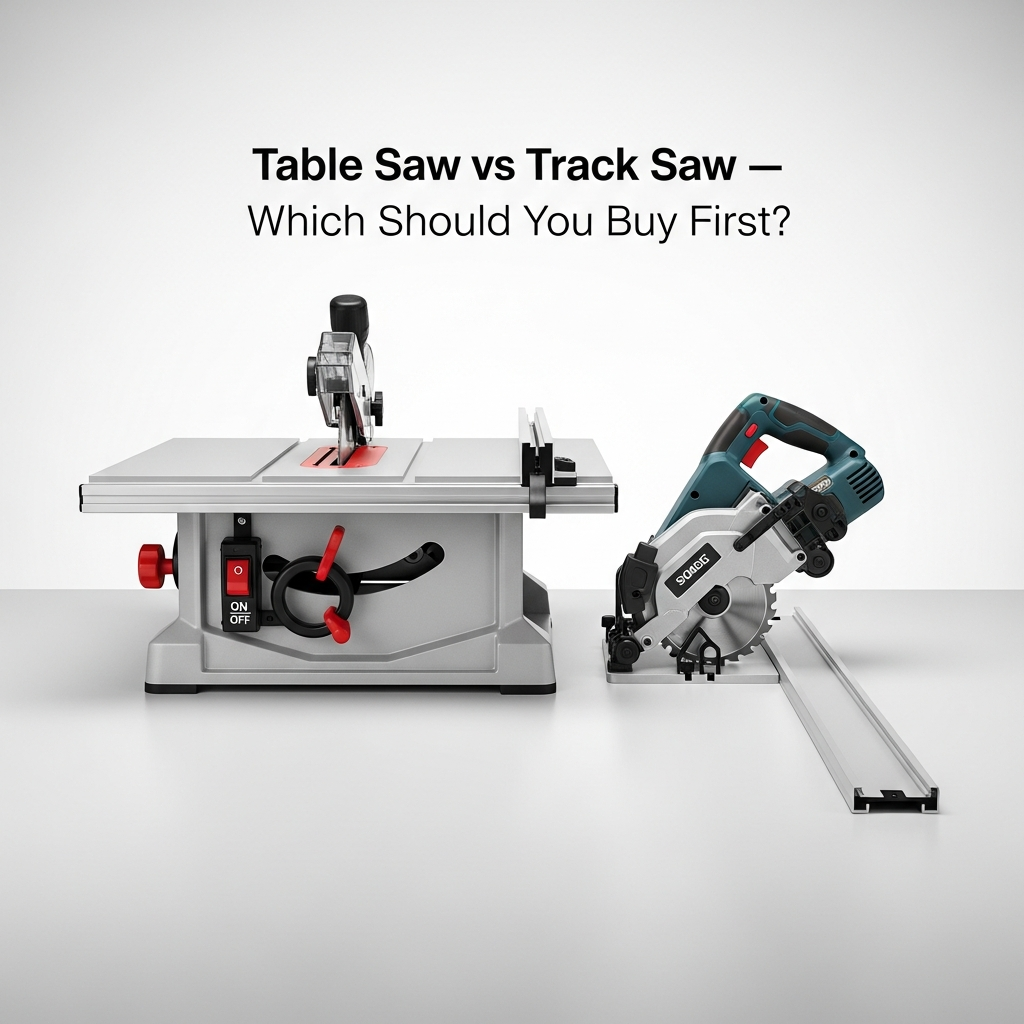
Table Saw vs Track Saw — Which Should You Buy First?
The table saw vs track saw debate has shifted noticeably with all the spec-sheet noise flying around woodworking forums. Horsepower ratings, blade diameters, dust port configurations — none of that helps you figure out what to actually do with $600 to $1,200 burning a hole in your pocket. As someone who’s owned both for several years now — a SawStop Contractor Saw and a Festool TS 55 REQ — I put in the hours studying this particular decision. The honest answer has almost nothing to do with the tools themselves. It’s about where you’re working and what you’re building.
The First-Purchase Decision Framework
Before we talk specs, let’s talk about your shop. Not your dream shop. Your actual shop, right now.
Frustrated by wasted lumber and a blown budget, I made my first big tool purchase using logic that felt completely airtight at the time. I bought a contractor table saw for a one-car garage — roughly 12 by 20 feet, concrete floor, one overhead light that was never quite enough. I needed to process 4×8 sheets of plywood for cabinet carcasses. What I failed to account for was the math: a 4×8 sheet coming off a table saw needs around 8 feet of infeed and 8 feet of outfeed. My garage was 12 feet wide. You can probably see where this is going. Six months of wrestling full sheets into a space that simply wasn’t built for it. Cursing every single time.
Avoid the path I took.
Here’s a simple framework. Answer these honestly:
- Is your workspace smaller than 400 square feet — or shared, like a garage you also park a car in?
- Do you work primarily with plywood, MDF, or sheet goods?
- Do you take work to job sites, or work inside clients’ homes?
- Is portability a practical requirement, not just a nice-to-have?
Two or more yes answers? Buy the track saw first. Full stop.
Now the other side:
- Do you have a dedicated workshop of 300 square feet or more that’s yours to use freely?
- Do you build furniture, cut dadoes and rabbets, or work with solid lumber in any real volume?
- Are you planning to run jigs — box joint jigs, tapering jigs, crosscut sleds?
- Do you need repeatable cuts dozens of times on a single project?
Mostly yes? Table saw is your first call.
The reason nobody frames it this way is that most review articles are written by people comparing tools on paper — not by someone who’s actually dragged both through real projects in a real shop. Workshop size and project type are the variables that matter. Blade diameter and motor amps are secondary. Honestly, pretty far secondary.
What a Table Saw Does That a Track Saw Cannot
Worth flagging before going further, because it gets at the core question of capability.
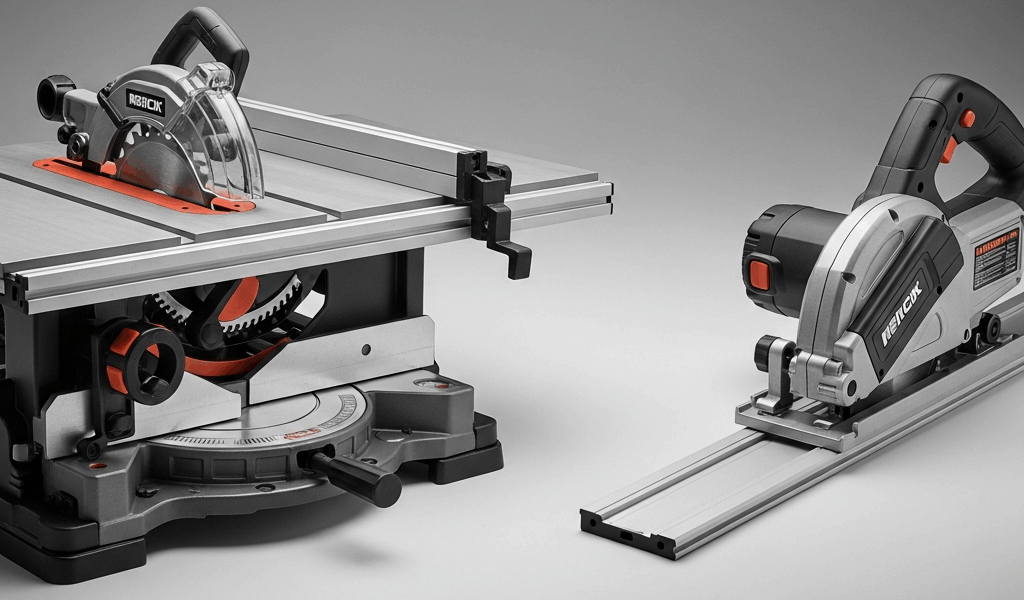
But what is a table saw, really? In essence, it’s a stationary blade mounted in a flat reference surface with a fence system that locks cut width in place. But it’s much more than that — it’s the production backbone of a woodworking shop in a way no other tool quite replicates.
Once the fence is set, you can run 40 identical rip cuts and every single one will be the same width. 2-1/4 inches, 5-1/8 inches, whatever the project demands. A track saw requires you to measure and clamp a track for every cut, or at minimum re-verify your position each time. At scale, that difference becomes enormous.
Repetition and the Fence System
The rip fence is the table saw’s superpower — full stop. I’m building a set of kitchen cabinet doors right now — 18 doors, all needing 2-inch stiles and rails ripped from 4/4 hard maple. That’s 72 individual pieces. I set the fence on my SawStop to exactly 2 inches, confirmed it with a Starrett rule, and ran every piece in about 40 minutes. No re-measuring. No re-clamping. Try doing that with a track saw and tell me how your afternoon goes.
Dado Stacks and Joinery
A track saw cannot cut dados. This isn’t a knock on the tool — it’s just physics. A table saw with a dado stack becomes a joinery machine. Dado and rabbet joints for cabinet cases, half-lap joints for frames, tenon cheeks for mortise-and-tenon work — all of this lives in the table saw’s domain. I run an 8-inch Freud dado set, and it’s probably the single most-used configuration in my shop after a standard rip blade.
If you’re building anything requiring structural joinery — furniture, face frames, boxes with real corner joints — the table saw is doing work no track saw can replicate. A router table can cover some of this ground, sure. But a router table is a second purchase, not a substitute for the saw itself.
Jigs and the Flat Reference Surface
The table saw’s flat, stable surface is a platform for jigs that expand the tool’s capability dramatically. A crosscut sled gives you precision square cuts that beat most miter saws for accuracy. A tenoning jig lets you cut tenon cheeks vertically with stock standing upright. A tapering jig turns straight cuts into tapered legs for tables and chairs. None of this works with a track saw — the tool moves while the workpiece stays still. On a table saw, the workpiece moves along a fixed, repeatable path. That’s what makes it endearing to us furniture builders in a way that’s hard to explain until you’ve experienced it.
What a Track Saw Does Better
The track saw is one of the most underestimated tools in woodworking, especially among people who came up with a table saw already in the shop. I resisted buying one for years. Apparently, I enjoy making things harder than they need to be. That was dumb.
Breaking Down Sheet Goods
This is where the track saw is simply the superior tool — and it’s not particularly close. A full sheet of 3/4-inch cabinet-grade Baltic birch plywood weighs around 60 to 70 pounds. Feeding that into a table saw alone, in a small shop, is genuinely dangerous. You’re fighting the weight the whole time, the blade can catch if the sheet flexes even slightly, and without solid outfeed support, the back end drops mid-cut. People get hurt doing this.
With a track saw, you put the sheet on a pair of foam insulation boards on the floor, lay the track across it, let the rubber grip strips hold everything in place, and cut. The sheet doesn’t move. You move along the sheet with the saw. The Festool TS 55 with the 1.4-meter guide rail handles a full sheet crosscut in a single pass — maybe 90 seconds from setup to finished cut. That’s it.
Tearout-Free Cuts
Track saw blades — particularly the Festool blades paired with the TS 55 — produce cuts so clean they’re essentially ready to glue or finish. The splinter guard on the track rail and the scoring geometry of the blade work together to eliminate the tearout you almost always get on the underside of a plywood cut on a table saw, even with a quality blade. For visible panels, veneered plywood, or melamine-faced sheet goods, this matters. A lot, actually.
No Dedicated Space Required
A track saw lives in a case. The Festool TS 55 REQ fits in a Systainer roughly the size of a large carry-on bag — I’ve taken mine on a job site in the back of a Subaru Outback with room left over for a cooler and a set of clamps. A 10-inch contractor table saw weighs between 200 and 300 pounds and requires a permanent footprint. For anyone working in a shared space, a rented workspace, or a small garage, the track saw’s portability isn’t a luxury. It’s the only option that actually works.
Safety in Tight Conditions
There’s a real safety argument here that doesn’t get enough airtime. A track saw with a riving knife and blade guard operating in a fixed track is a significantly safer tool for solo operators dealing with large sheet goods than a table saw where the workpiece has to be controlled entirely by the operator’s body position and grip strength. This doesn’t mean table saws are dangerous in general — they’re not, when used correctly. But for a solo woodworker breaking down sheets alone in a cramped space, the track saw is the lower-risk tool. Worth saying plainly.
The Verdict — Buy This One First
Here it is. No hedging.
For the majority of woodworkers — people with a dedicated shop space who want to build furniture, do joinery, run production cuts, and eventually get into more complex techniques — buy the table saw first. A solid contractor saw like the DeWalt DWE7491RS at around $600 to $700 will serve you for years and do things a track saw simply cannot. The table saw is the center of a woodworking shop. Everything else gets set up around it.
But for job-site carpenters, finish carpenters, woodworkers in apartments or small shared garages, people who work primarily with sheet goods, or anyone who truly cannot commit 20-plus square feet of permanent floor space to a single tool — buy the track saw first. The Makita SP6000J1 runs around $500 and is an excellent non-Festool option that pairs with standard guide rails. The Festool TS 55 REQ at around $700 is the benchmark if you can stretch the budget.
These aren’t compatible roles — one tool does not replace the other. Eventually, if you stay in woodworking seriously, you’ll own both. The day you get that second one, you’ll understand immediately why both exist. But the first purchase gets decided by where you are right now, not by which tool has the more impressive spec sheet.
Small shop, lots of plywood, limited square footage — track saw might be the best option, as sheet goods processing requires mobility and floor space you probably don’t have. That is because the table saw math simply doesn’t work in tight conditions, no matter how much you want it to.
Dedicated workshop, solid lumber, joinery, variety of project types — table saw. Everything else grows from there.
The mistake I made was buying for the shop I wanted instead of the shop I had. Buy for the work you’re doing right now, in the space you actually have, and upgrade the rest as the projects demand it.




Stay in the loop
Get the latest artisan furniture makers updates delivered to your inbox.