Biscuit Joiner vs Pocket Hole Jig for Furniture
The biscuit joiner vs pocket hole jig debate has turned into a moving target with all the gear tribalism flying around woodworking forums. I’ve built furniture using both tools extensively — face-frame cabinets, solid walnut tabletops, dining chairs, painted MDF casework — and the honest answer is that neither tool wins universally. They solve different problems. Treating them as substitutes is the mistake, because they’re actually filling different roles depending on what part of the furniture you’re joining.
What Each Tool Actually Does to a Joint
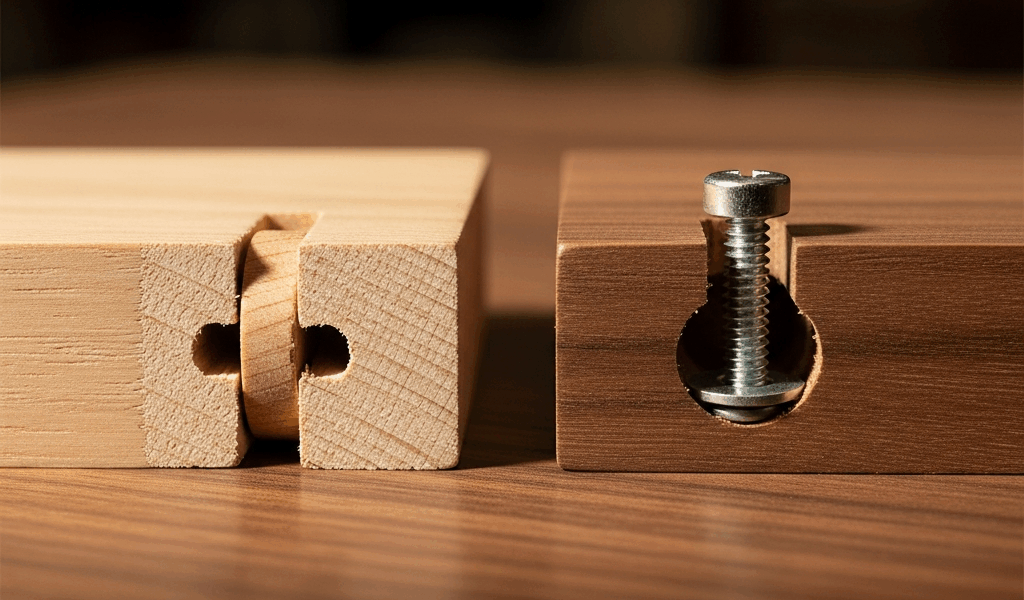
But what is a biscuit joiner, exactly? In essence, it’s a tool that cuts a crescent-shaped slot into both mating faces. But it’s much more than that. You insert a compressed beech biscuit — typically a #20 for furniture work — apply glue, and clamp. The biscuit absorbs moisture from the glue and swells, creating a registered, glue-dependent connection. Without glue, a biscuit joint has almost no structural value. It’s a glue joint, full stop.
A pocket hole jig — the Kreg R3 at around $35 or the Kreg 720PRO at around $170 being the two most common in furniture shops — bores an angled pilot hole and counterbore simultaneously, then pulls two parts together with a coarse-thread screw. The connection is mechanical. You can assemble a pocket screw joint without any glue and it will hold under load. Glue is optional, though adding it improves long-term rigidity considerably on furniture that racks or flexes during use.
That distinction matters more than most comparisons acknowledge. One joint lives or dies by glue surface. The other works with or without it. That’s what makes each tool endearing to us furniture makers in completely different situations.
Strength and Racking Resistance Compared
Pocket screws win on raw assembly speed. No clamps needed, joints go together fast, and the screw shank resists lateral movement when fastened into good material. Where they fall short is shear strength on edge-to-edge glue-ups. A tabletop with pocket screws added for alignment isn’t meaningfully stronger than a well-glued edge joint on its own — the screws are mostly in the way at that point.
Biscuits don’t add dramatic strength to an edge glue-up either. The wood-to-wood glue surface does the real work. What biscuits actually do is index the boards so faces stay flush during clamping. That’s their job in a tabletop. For furniture failure in the real world, a tabletop doesn’t fail at the glue line. It fails because the base racked, a tenon dried out and cracked its mortise, or someone left it in a garage through two winters.
For face frames, pocket screws resist racking better than biscuits because the screw mechanically locks the joint even if the glue creeps slightly over years of use. Chair rails are the one application where I’d trust neither tool alone — but between the two, biscuits at least distribute stress across a wider glue face on the rail cheeks.
Best Applications for Each Tool in Furniture Builds
Worth saying out loud. This is where the actual decision lives. So, without further ado, let’s dive in.
Tabletop Edge Glue-Ups
Biscuit joiner wins here. The #20 biscuit registers board faces so you’re not chasing alignment during a multi-board glue-up with eight clamps in play and the glue already starting to tack. I’ve tried doing this without biscuits. Ended up with a tabletop that needed an extra 45 minutes of hand planing to flatten. The biscuits don’t add structural strength the glue isn’t already providing — they just save you from a miserable clamping session. Save yourself the trouble I had.
Face Frame Assembly
Pocket hole jig wins. Fast, strong enough for the application, and you can assemble a face frame flat on a bench without clamps holding pieces while you fumble with biscuit slots. The Kreg 720PRO with a face clamp makes face frame work genuinely quick. On painted face frames, the pocket holes end up on the back face and nobody ever sees them. On stained or clear-finished frames, you need to think about placement more carefully — at least if you care about a clean final result.
Cabinet Carcass Assembly
Pocket hole jig wins again, particularly for plywood casework. I built a run of nine base cabinets for a kitchen using 3/4-inch Baltic birch and Kreg 1-1/4 inch coarse-thread screws throughout. The boxes came out square and solid without a single clamp. That was 2019. Those cabinets are still perfect. Biscuits in plywood carcass work are slower to set up and offer no mechanical advantage over pocket screws on sheet goods.
Chair Rails and Aprons
Neither tool is ideal here. Chairs experience forces in every direction — every time someone leans back or drags the chair across a hardwood floor, those rails are torqued hard. Biscuits in chair rail joints fail in racking before the wood does. Pocket screws work reasonably well for painted or production furniture with short lifecycles, but for a solid hardwood dining chair you expect to last decades, cut the mortise-and-tenons. Use the pocket jig to assemble a temporary clamping reference if you want. Just don’t rely on it structurally.
Drawer Boxes
Pocket hole jig wins on plywood drawer boxes. Lock rabbet joints are better if you’re milling solid wood drawer boxes, but for shop-grade or painted plywood, pocket screws at the corners with glue produce a drawer box that will outlast most furniture it goes into. Biscuits in drawer box corners are difficult to register accurately and add setup time that pocket screws eliminate entirely.
Setup Time, Learning Curve, and Shop Workflow
Frustrated by a misaligned joint on a cherry cabinet side during my third year building furniture, I spent months getting comfortable with how these two tools behave differently under real shop conditions. Today, I will share it all with you.
The Kreg R3 — around $35, nothing fancy — is genuinely beginner-friendly. You clamp it to the workpiece, drill, done. Depth settings are clear, the indexing is forgiving, and mistakes are uncommon on the first use. A biscuit joiner like the DeWalt DW682K requires more deliberate layout. You’re marking centerlines, registering the fence consistently, making sure your slot depth matches across both mating pieces. Get that wrong and your joint face is offset by 1/16 inch. Visible on furniture. Painful.
I’m apparently sensitive to fine dust and the DeWalt throws a significant amount during cuts — the shop vac port helps but never fully solves it. Biscuit joiners also cause tearout at the slot opening on finished or nearly finished faces. Use a sharp blade and test on scrap first. Pocket screws on finished faces can blow out the exit point if you’re driving into thin material. 1/2-inch stock is about the minimum for reliable results without backing it up with a scrap block clamped behind the exit point. Simple fix that cost me a panel to figure out. Steer clear of where I went wrong.
Which One Should a Furniture Maker Buy First
While you won’t need both tools immediately, you will need a handful of decisions made upfront about what you actually build most.
First, you should buy the pocket hole jig — at least if you build casework, shelving, face frames, or plywood-heavy furniture. The speed advantage is real and the learning curve is minimal. The Kreg 720PRO at around $170 handles almost everything in a casework-focused shop.
The biscuit joiner might be the best option, as solid wood furniture requires reliable alignment during glue-ups. That is because misaligned boards during clamping cost you hours of flattening work afterward. The DeWalt DW682K runs around $180 and is reliable enough that I’ve used mine for over six years without a complaint.
If you build both casework and solid wood furniture and can only choose one right now, get the pocket hole jig. You can manage tabletop alignment with careful clamping and cauls. You cannot easily substitute a biscuit joiner for the mechanical fastening that makes face frame and carcass work efficient. Start with the tool that removes the most friction from your most common builds, then add the other when the workflow actually demands it.



Stay in the loop
Get the latest artisan furniture makers updates delivered to your inbox.