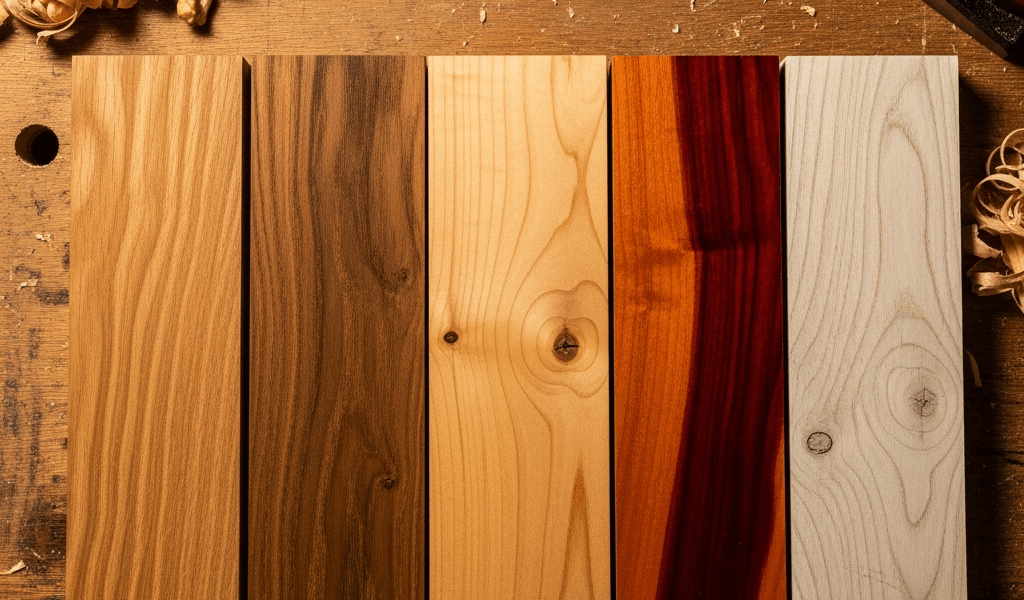
What Actually Matters When Picking a Tabletop Wood
Picking wood for a dining table has shifted noticeably with all the conflicting advice flying around. Everyone’s got an opinion — the guy at the lumber yard, the Reddit thread from 2019, the YouTube woodworker with the expensive shop. As someone who has built enough tables to fill a restaurant and then some, I spent real time learning the ins and outs of what actually separates a good tabletop wood from a disaster waiting to happen. Today, I will share it all with you.
The wrong wood in the wrong situation means a top that dents under a coffee mug, blotches under your first coat of stain, or cups so badly by February that the breadboard ends start pulling away. I’ve made all of those mistakes. This article exists so you don’t have to.
Before comparing specific species, here are the criteria that actually drive the decision:
- Hardness and dent resistance — Janka ratings give a rough baseline, but density consistency across the board matters more than a single number.
- Grain pattern and finish telegraphing — Open-grain woods behave completely differently under a topcoat than tight-grain species. This affects gloss level, filler requirements, and the entire finishing sequence.
- Workability with common shop tools — How does the wood behave at the jointer, through the planer, and under a hand plane? Some species punish dull tooling badly.
- Seasonal movement and stability — A dining table top is typically 36 to 42 inches wide. Wood movement across that span is real and species-dependent.
- Price per board foot — Budgets are finite. Knowing where each species sits helps you scope a project honestly.
Those five criteria frame everything below. No filler. Just what you need to make the call. So, without further ado, let’s dive in.
Hard Maple vs White Oak vs Walnut vs Ash
Hard Maple
Hard maple runs about $6–$9 per board foot at most regional hardwood dealers. Dense — 1,450 on the Janka scale. It machines beautifully when your tooling is sharp. Dull blades telegraph immediately as fuzzy grain and tearout at the jointer, so don’t cheap out on carbide. The big upside is maple’s closed, tight grain, which means blotching under oil-based stains stays minimal compared to softer species. It doesn’t take dark stains gracefully — honestly, don’t even try. But for painted tops or a simple Rubio Monocoat oiled finish, maple performs. Hard to beat for a Scandinavian-style build or a painted kitchen-adjacent dining table where durability is the whole point. That’s what makes maple endearing to us builders who care more about longevity than showmanship.
White Oak
White oak sits around $7–$11 per board foot and is probably the most well-rounded choice on this list. Janka rating of 1,360 — slightly softer than maple but more forgiving to work with. The open grain is the main consideration. For a glassy film finish, you need grain filler or multiple rounds of sanding sealer, or you’ll see the pores under your topcoat for years. White oak takes water-based polyurethane remarkably well without the tannin-yellowing issues that plague red oak. It’s also one of the more stable domestic hardwoods across seasonal swings — especially when you can source quartersawn stock, which is worth every extra penny.
Walnut
Walnut is expensive. Figure on $12–$18 per board foot for clean, wide stock. Softer than both maple and oak at 1,010 Janka, which surprises people given its reputation. It dents. A ring from a ceramic bowl left on a walnut top with a thin oil finish will show. I know this firsthand — my own dining table wears a faint ring from a candle holder I left out one winter. That said, walnut is genuinely stunning, and no species on this list rewards an oil or oil-varnish finish the way walnut does. The grain figure practically glows under Waterlox or a hand-rubbed Danish oil blend. Built right, with proper protection and for the right household, a walnut top becomes an heirloom. Just know what you’re buying.
Ash
Ash is the underrated one. Priced around $4–$7 per board foot — often cheaper depending on your region. Janka rating of 1,320. Outstanding shock resistance that historically made it the choice for baseball bats and tool handles. The grain is open like oak, which creates similar finishing considerations, but ash tends to have a cleaner, more consistent figure that some makers prefer over oak’s sometimes chaotic ray patterns. It machines well, glues up easily, holds fasteners reliably. One real caveat: the emerald ash borer has reduced domestic supply in some areas significantly. Check availability locally before committing an entire project to it.
Quick Comparison
| Species | Janka | Grain Type | Price/BF (approx.) | Best Finish Type |
|---|---|---|---|---|
| Hard Maple | 1,450 | Closed | $6–$9 | Paint, light oil |
| White Oak | 1,360 | Open | $7–$11 | Water-based poly, oil |
| Walnut | 1,010 | Semi-open | $12–$18 | Oil, oil-varnish |
| Ash | 1,320 | Open | $4–$7 | Water-based poly, oil |
Which Wood Causes the Most Finishing Problems
Worth flagging before going further. Finishing failures are where projects completely unravel — and each of these species has at least one trap waiting for you.
Maple and oil-based stain blotching — Maple’s closed grain absorbs stain unevenly, leaving dark blotchy patches that look like bruising on the surface. The fix is a pre-conditioner. Minwax Wood Conditioner works in a pinch, though I’m apparently a shellac person and Zinsser SealCoat works for me while commercial conditioners never quite get there. Mix it to a 1-lb cut, diluted with denatured alcohol, and apply it before staining. It levels out absorption and gives you a much more uniform color. Don’t skip it on maple if you’re going darker than the natural tone. Spare yourself the wrong turn I took.
White oak and tannin reactivity — White oak has high tannin content. Apply a water-based poly directly over raw white oak and you can get a greenish-gray discoloration in the grain pores where the tannins and water interact. The fix is straightforward: seal the oak first with a single coat of oil-based finish or an oil-based sanding sealer, let it cure fully, then topcoat with your water-based product. A dewaxed shellac barrier coat does the same job. Either way — don’t skip the barrier step.
Walnut under the wrong topcoat — Walnut finished with a heavy-build water-based polyurethane often looks washed out and flat. The plastic-looking film sits on top of the wood rather than integrating with it, and you lose the depth that makes walnut worth $15 a board foot. Use Waterlox Original or an oil-varnish blend like General Finishes Arm-R-Seal on walnut. If a client insists on water-based for off-gassing reasons, apply a single coat of boiled linseed oil and let it cure for a full week before topcoating — it restores most of the depth you’d otherwise lose.
Ash grain pores under gloss — Same category as oak. If you want a high-gloss film finish on ash, fill the grain first. System Three’s Gel Gloss or a paste grain filler applied before your first topcoat will save you three extra sanding and coating cycles. Worth the extra afternoon of work.
Stability and Wood Movement Over a Wide Dining Table
A 40-inch-wide dining table top will move. Accept that upfront. The question is how much — and whether your chosen species and cut will keep that movement manageable enough to not cause structural headaches.
But what is wood movement, really? In essence, it’s the expansion and contraction of wood fibers as humidity changes throughout the year. But it’s much more than that. It’s the difference between a top that stays flat for decades and one you’re re-flattening every spring.
Movement comes down to two numbers: radial shrinkage, which runs perpendicular to the growth rings — the direction quartersawn lumber shrinks — and tangential shrinkage, which runs parallel to the rings — the direction flatsawn lumber shrinks. Tangential movement is always larger. Typically 1.5 to 2 times greater than radial movement, depending on species.
Ash and hard maple have relatively high tangential shrinkage rates — around 7.8% and 9.9% respectively. Across a 40-inch-wide flatsawn glue-up, that’s real seasonal movement you’ll feel. White oak’s tangential shrinkage sits at around 7.2%, and walnut lands at about 7.8%, but both tend to behave more predictably in practice because of how their cell structure handles moisture cycling over time.
For any wide dining table top — especially in a climate with significant humidity swings — quartersawn or riftsawn lumber is worth seeking out. Yes, it costs more and yield is lower. Quartersawn white oak is remarkably stable, and quartersawn maple moves far less than its flatsawn equivalent. Build your top with flatsawn boards and you’ll be re-flattening that surface at some point. Build with quartersawn stock and you probably won’t.
Which Wood Should You Actually Use
Here’s the decision matrix without the hedging.
Budget build or first dining table project — use ash. It’s affordable, forgiving to work with, strong enough for daily use, and takes a finish well once you understand the open grain. You can build a table that looks and performs like a $2,000 piece for under $400 in material. That’s what makes ash endearing to woodworkers who are still figuring out their process.
Heirloom piece with a dark, natural finish — use walnut. Accept the higher cost and the softer surface. Use Waterlox or an oil-varnish blend. Build it for someone who understands wood and will treat it accordingly. The result will be extraordinary — at least if you’re willing to put in the finishing work that walnut demands.
High-traffic family table with kids — use white oak. It’s hard enough to take daily punishment, stable enough across seasons to stay flat, and takes a durable water-based finish well once you manage the tannin issue. Quartersawn white oak with two coats of General Finishes Enduro-Var is a legitimate bulletproof combination. I’ve seen these tops survive years of homework, craft projects, and dinner parties without complaint.
Painted or Scandinavian-style minimalist table — use hard maple. The tight grain reads beautifully under paint and won’t telegraph wood texture through the topcoat the way open-grain species do. For a natural finish in this style, a single coat of Rubio Monocoat Oil Plus 2C in Pure or White is the right call — it enhances the wood without overpowering it.
Every one of these choices is defensible. None of them is wrong. The trap is spending weeks researching and then picking the most expensive option out of anxiety. Match the wood to the use case, understand the finishing requirements going in, and build the table.

Stay in the loop
Get the latest artisan furniture makers updates delivered to your inbox.